
Most first-time owners don't call an accountant until something breaks: a payroll run comes up short, a tax notice lands in the mailbox, or the bank asks for financial statements nobody has prepared. By then, the fix costs more than the help would have.
So should you hire an outsourced accounting firm? For most new owners, yes, and sooner than you'd expect, though rarely on the day you open. Once you're running payroll, handling steady transactions or answering to a lender, guessing gets expensive.
Plenty of owners end up sorting receipts at 11 p.m., unsure whether a quarterly tax payment was due last week, and staring at a bank balance that doesn't match how busy they've been. Year one does that to almost everyone. It's also fixable.
TL;DR Quick Answers
Hire Outsourced Accounting Firm
Hire an outsourced accounting firm once your business runs payroll, handles steady transactions or reports to a lender. You get a full team's oversight of your books for a flat fee, at a fraction of what one in-house accountant costs.
When to hire: your books are more than a month behind, you're running your first payroll, or a lender or investor wants financials.
What you get: monthly bookkeeping and closes, reviewed financial statements and a clear view of cash flow.
What it costs: a flat fee based on scope. An in-house accountant earns a median $81,680 a year before benefits, according to the BLS.
What to look for: a team with built-in review instead of one person, fixed pricing, strong data security and direct coordination with your CPA.
When to wait: outsourcing isn't always cheaper. A very early, low-volume business can often start with good software and an annual CPA visit.
Top Takeaways
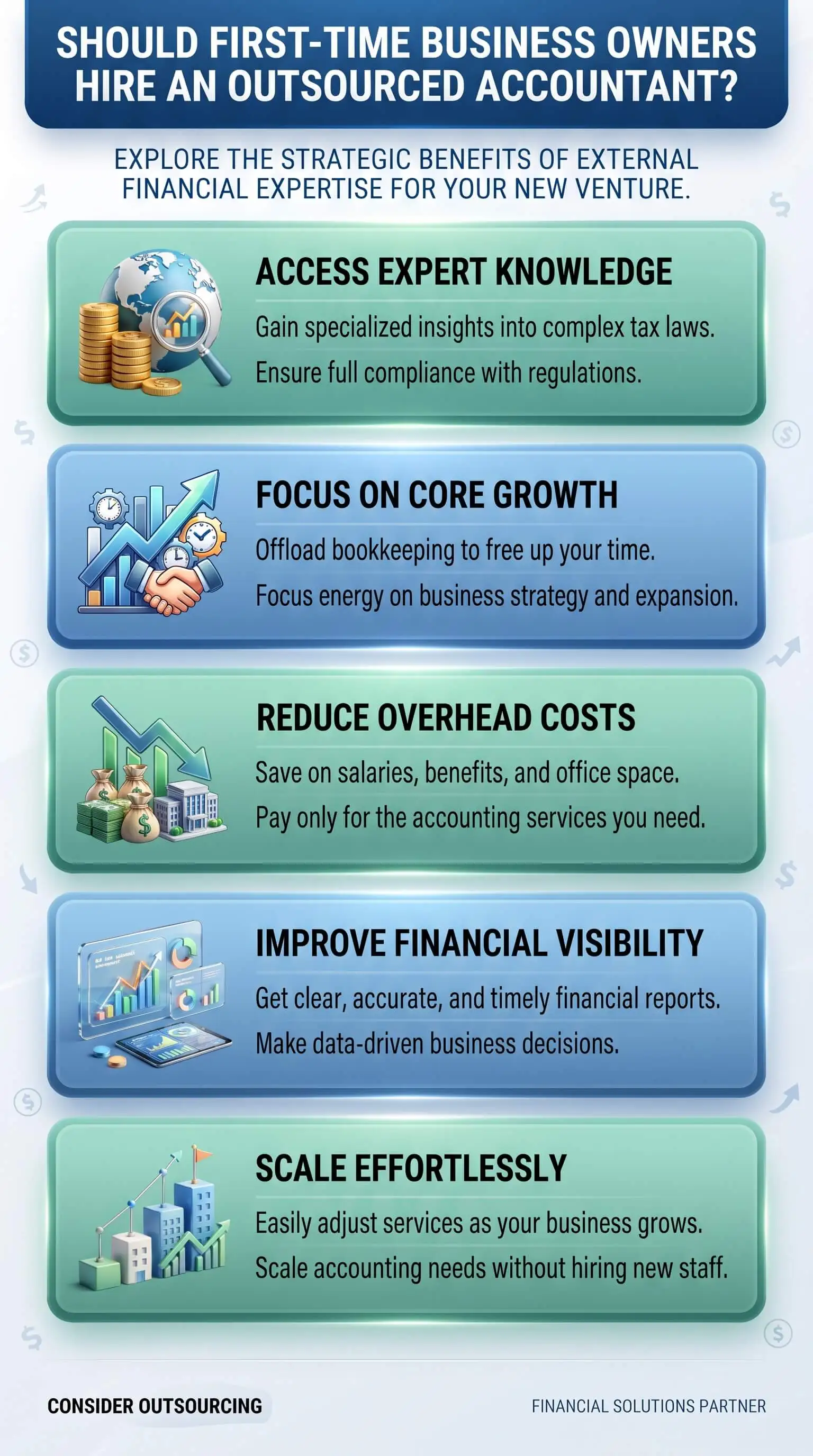
Outsourced accounting gives new owners professional books without the cost of a full-time hire.
You rarely need it on opening day. First payroll, steady transaction volume or financing usually signals it's time.
Bookkeepers, accountants, fractional CFOs and tax CPAs do different jobs, so know which one you need.
Compare the full cost, not just the fee. An in-house accountant's median wage alone is about $81,680 a year.
Vet firms on team review, data security, fixed pricing and how they work with your tax preparer.
The right partner grows with you and tells you honestly when you aren't ready.
What Does an Outsourced Accountant Do for a New Business?
An outsourced accountant is an outside professional or team that runs your accounting and financial controls under contract, so you get the expertise without adding staff. The practice is called accounting outsourcing, and for a small business the work falls into two layers:
Transaction work: bookkeeping, bill pay, invoicing, payroll support, and bank and credit card reconciliations
Advisory work: monthly financial statements, budgets, forecasts and cash-flow planning
New owners mix up the roles constantly, so it helps to know who handles what:
Bookkeeper: records transactions and keeps the books current
Outsourced accountant or controller: reviews the books, closes each month and produces financial statements you can trust
Fractional CFO: turns those numbers into decisions about pricing, hiring and fundraising
Tax CPA: prepares and files your returns
Watch that last role closely, because not every outsourced firm files taxes. Some, including Accountix, keep your books tax-ready and work directly with your CPA instead of preparing returns themselves. Whether you're hiring an accounting firm or seeking outsourced family office executive services, ask before you sign so nobody assumes someone else has it covered.
The Financial Mistakes First-Time Owners Make Most Often
Most owners who fall behind on their books aren't careless. Nobody told them what to watch for. These mistakes come up again and again:
Mixing personal and business money: one shared card turns tax prep into an archaeology project.
Confusing profit with cash: your P&L shows a great month while your bank account tells a different story.
Missing estimated taxes: quarterly payments catch anyone used to a W-2 paycheck off guard.
Letting the books slide: three months behind turns into an expensive catch-up job at tax time.
Keeping thin records: the IRS expects you to keep records as long as you need them to prove the income and deductions on your return, and to hold employment tax records for at least four years.
Picture a first-year agency owner who signs a big retainer. Revenue looks great on paper. But the client pays on net-60 terms, payroll is due in two weeks, and without a cash-flow forecast nobody sees the gap coming. The business has a visibility problem rather than a sales problem, and that's exactly what a good accounting partner flags early.
When Should You Hire an Outsourced Accounting Firm?
The right answer depends on your stage.
Pre-revenue or very early: accounting software plus a one-time setup session with a pro usually covers it. Set up your chart of accounts and business bank accounts correctly from the start.
Steady transactions or your first hire: bring in outsourced bookkeeping. Payroll adds compliance work that's easy to get wrong.
Growth, multiple revenue streams or lender reporting: move to a full outsourced accounting team that closes your books every month and reviews the financials.
Big strategic decisions: add fractional CFO support for pricing, forecasting and capital planning. Agency owners can see how that plays out in our look at fractional CFO services for Los Angeles marketing agencies.
You probably need to hire an outsourced accounting firm now if any of these sound familiar:
Your books are more than a month behind.
You spend five or more hours a week on finance tasks.
You're about to run payroll for the first time.
A lender or investor wants to see your financials.
Choose an outsourced accounting firm that can grow with you, so you don't have to switch providers every time your needs change. Accountix, for example, assigns each client a team of controllers, a CPA and a client CFO and builds reviews into the process, so your books never depend on one person's memory.
When Outsourcing Isn't the Right Move Yet
Outsourcing isn't automatically cheaper, and some businesses don't need it yet. A solo consultant with a handful of invoices a month, no employees and simple expenses can usually get by with good software and an annual visit to a CPA.
Even firms that sell the service will tell you so. Accountix's own FAQ admits outsourcing isn't always the cheaper option and that some businesses are better off hiring a bookkeeper. A partner who says that up front is one you can trust later.
Outsourced vs. In-House vs. DIY: What It Really Costs
What you pay depends on which option fits your stage:
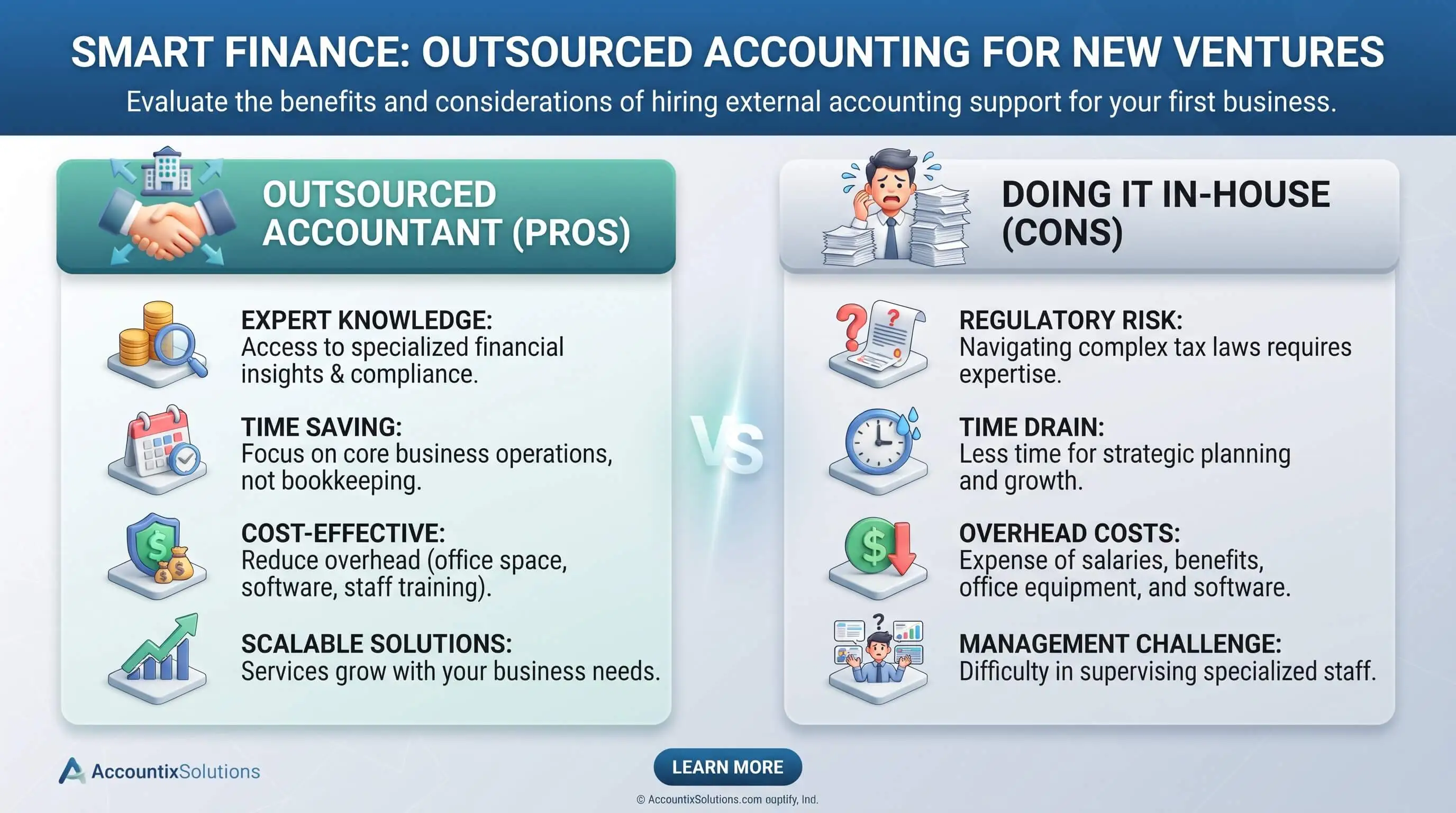
DIY with software: you pay only for a subscription. It works for very early, low-volume businesses, but it eats your hours, and small errors compound.
Bookkeeper: usually hourly or part-time. Full-time bookkeeping clerks earned a median of $49,210 a year in May 2024, according to the Bureau of Labor Statistics. A bookkeeper suits steady transactions and simple needs, though you're relying on one person and limited reporting.
Outsourced accounting firm: a flat fee based on scope. Accountix lists bookkeeping from $200 a week. This option fits growing businesses that need reviewed financials. What you give up is someone on-site every day.
In-house accountant: accountants and auditors earned a median wage of $81,680 a year in May 2024, according to the BLS, before benefits and payroll taxes. It makes sense for larger, more complex operations. It's also the highest fixed cost, and the knowledge walks out the door if that person leaves.
Look past the fee and add up the full cost, including your time and the price of mistakes. For a sense of what bookkeeping alone runs, see our guide to small-business bookkeeping costs in Santa Barbara.
How to Vet an Outsourced Accounting Firm Before You Sign
Ask these questions before anyone touches your books:
Who works on my books: one person, or a team with built-in review?
Which software do you use, and do I keep full ownership of and access to my data?
Is your pricing fixed and scoped, or hourly?
How do you coordinate with my tax preparer?
How do you protect my data? Look for encryption, access controls and two-factor authentication.
How long does onboarding take, and will you handle catch-up work if I'm behind?
Can you scale with me from bookkeeping to CFO-level support?
When looking for the best outsourced business and financial accounting firms, clear, specific answers are a good sign. Vague ones tend to turn into surprises later.
"Most first-year books we inherit were set up to record transactions, and almost none were set up to answer the questions an owner eventually asks. On catch-up projects, we spend more time rebuilding the chart of accounts so the P&L shows how the business actually makes money than we spend entering missing transactions. That's why we tell new owners to bring someone in before their first payroll instead of after their first tax notice. And if you're still a one-person shop with a dozen transactions a month, we'll tell you to wait. Good software and an annual CPA visit will carry you for now."
7 Essential Resources
SBA: Manage Your Finances: the Small Business Administration's plain-English guide to bookkeeping, accounting methods and financial statements.
IRS: Recordkeeping for Small Businesses: what to keep, why it matters and how long to hold on to it.
IRS: What Kind of Records Should I Keep: a practical rundown of the books your business has to maintain.
SCORE: Should You Hire an Accountant?: mentors walk new owners through the in-house versus outsourced decision.
U.S. Chamber of Commerce: Signs You Should Outsource Your Small Business Accounting: timing signals and commentary from CPAs on when to delegate.
BLS Occupational Outlook Handbook: Accountants and Auditors: pay and role benchmarks that put outsourcing costs in context.
Wikipedia: Accounting Outsourcing: a neutral overview of what businesses outsource, with the benefits and risks.
3 Statistics
Year one is the steepest drop. Among private-sector businesses that opened in March 2013, the survival rate fell 20.4 percentage points in the first year alone, and just 34.7% were still operating in 2023, according to the BLS.
Insight: Financial discipline matters most in the first twelve months, which is exactly when owners have the least time for it.
A full-time accountant is a big fixed cost. Accountants and auditors earned a median annual wage of $81,680 in May 2024, according to the BLS.
Insight: Add benefits, payroll taxes and software, and a full-time hire is out of reach for most early-stage budgets. Outsourced and fractional models close that gap.
Hourly help adds up fast. SCORE notes that CPAs may charge $100 to $300 an hour, depending on the market and how complex the work is.
Insight: Flat, scoped pricing turns accounting into a predictable monthly line item instead of a surprise bill.
These statistics highlight why early-stage businesses should consider outsourced accounting to maintain financial discipline, reduce hiring costs, and allocate resources wisely while recognizing the importance of sustainability in marketing and long-term business growth.
Final Thoughts and Opinion
We think most first-time owners should bring in outside accounting help sooner than they plan to. They can learn the basics, and they should. Their time is still worth more building the business than reconciling it.
Make it a stage decision rather than a status symbol. Start lean with good software and clean habits, add a bookkeeper when transactions pick up, and move to a full outsourced team once payroll, lenders or growth raise the stakes. Agency owners should tie those numbers to their profit margins early, because that's where clean books pay for themselves fastest.
Most of all, pick a partner who's honest with you, even about when you don't need them yet.
Key insight: Clean books keep you compliant, and they also let you make decisions faster than competitors who are still guessing.
Frequently Asked Questions
Do first-time business owners need an accountant right away?
Not always. A very early business with few transactions and no employees can often manage with accounting software and a one-time setup consult. Once payroll, steady sales or lender reporting enter the picture, professional help is worth it, because mistakes at that stage get expensive fast.
What's the difference between a bookkeeper and an outsourced accountant?
A bookkeeper records your transactions and keeps the books current. An outsourced accountant reviews that work, closes each month and produces financial statements you can rely on for decisions, lenders and taxes. Many outsourced firms provide both, so you get accurate data and someone checking it.
How much does it cost to hire an outsourced accounting firm?
Most firms charge a flat fee based on scope rather than an hourly rate, and the price depends on transaction volume, payroll and reporting needs. Accountix, for example, lists bookkeeping from $200 a week. That's a fraction of the $81,680 median annual wage for an in-house accountant, before benefits.
Will an outsourced accounting firm file my taxes?
That depends on the firm. Some prepare and file returns. Others, including Accountix, keep your books tax-ready and work directly with your CPA. Confirm this before you sign so you know exactly who's responsible for filing.
Is my financial data safe with an outsourced accountant?
It can be, as long as you vet the firm. Ask about encryption, access controls, audit trails and two-factor authentication, and make sure you keep ownership of and access to your accounting software. A reputable firm will answer those questions without hesitating.
When should I move from outsourced accounting to a fractional CFO?
Consider a fractional CFO when your questions shift from "Are the books right?" to "What should we do next?" Pricing strategy, hiring plans, fundraising and multi-year forecasts are CFO territory. Ideally, your accounting partner offers both so you don't have to switch firms.
Get Your Books Right From Day One
The habits you build in year one are the ones your business runs on for the next ten. Accountix, a Santa Barbara outsourced accounting firm, has helped growing businesses and nonprofits make confident financial decisions since 2015.
Book an intro call with Accountix to talk through where your books stand today. It's a 30-minute conversation with no obligation, just clarity.