
They meant well. Nobody told them you never promise outcomes, or that your practice sounds calm and never urgent.
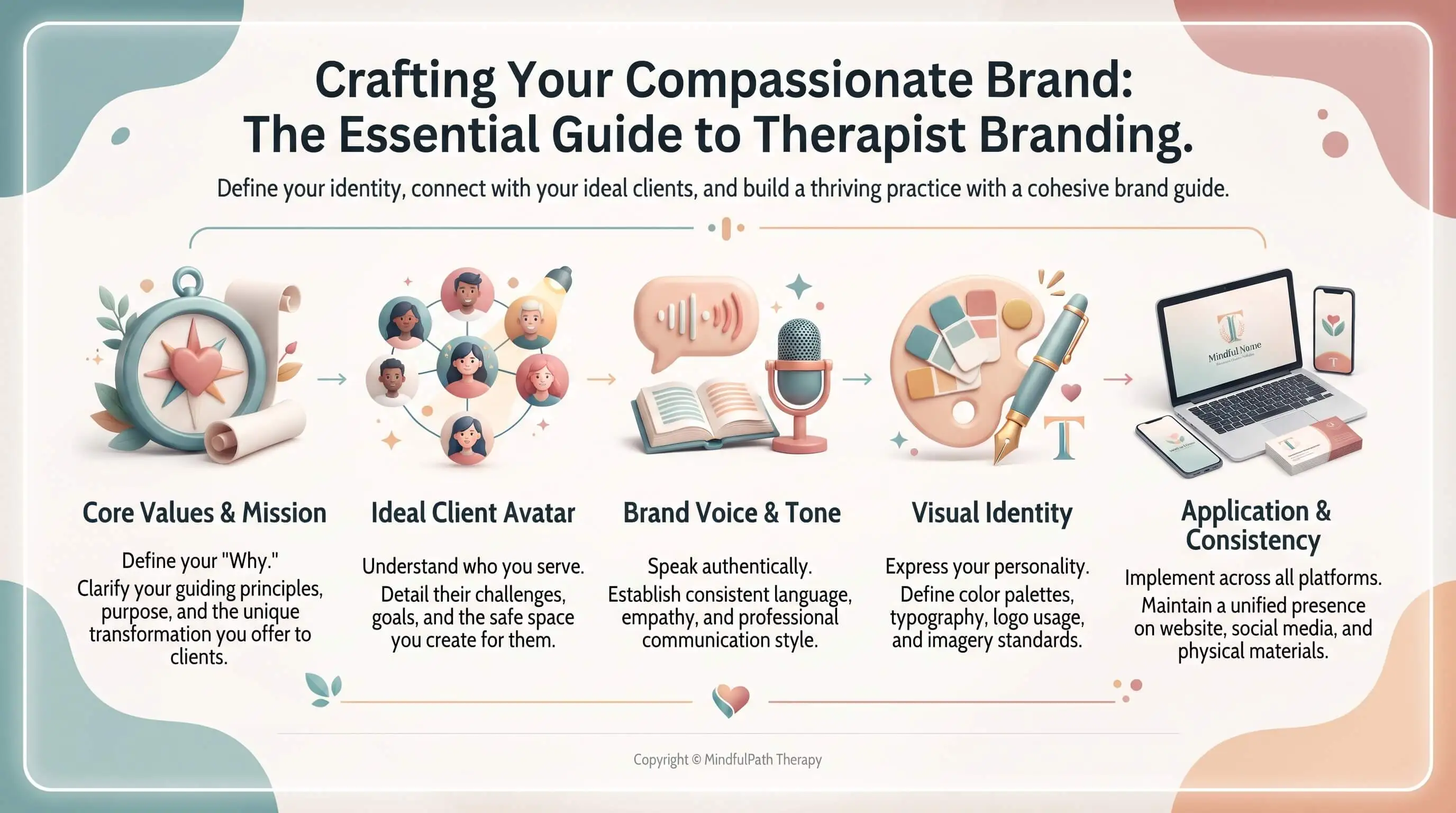
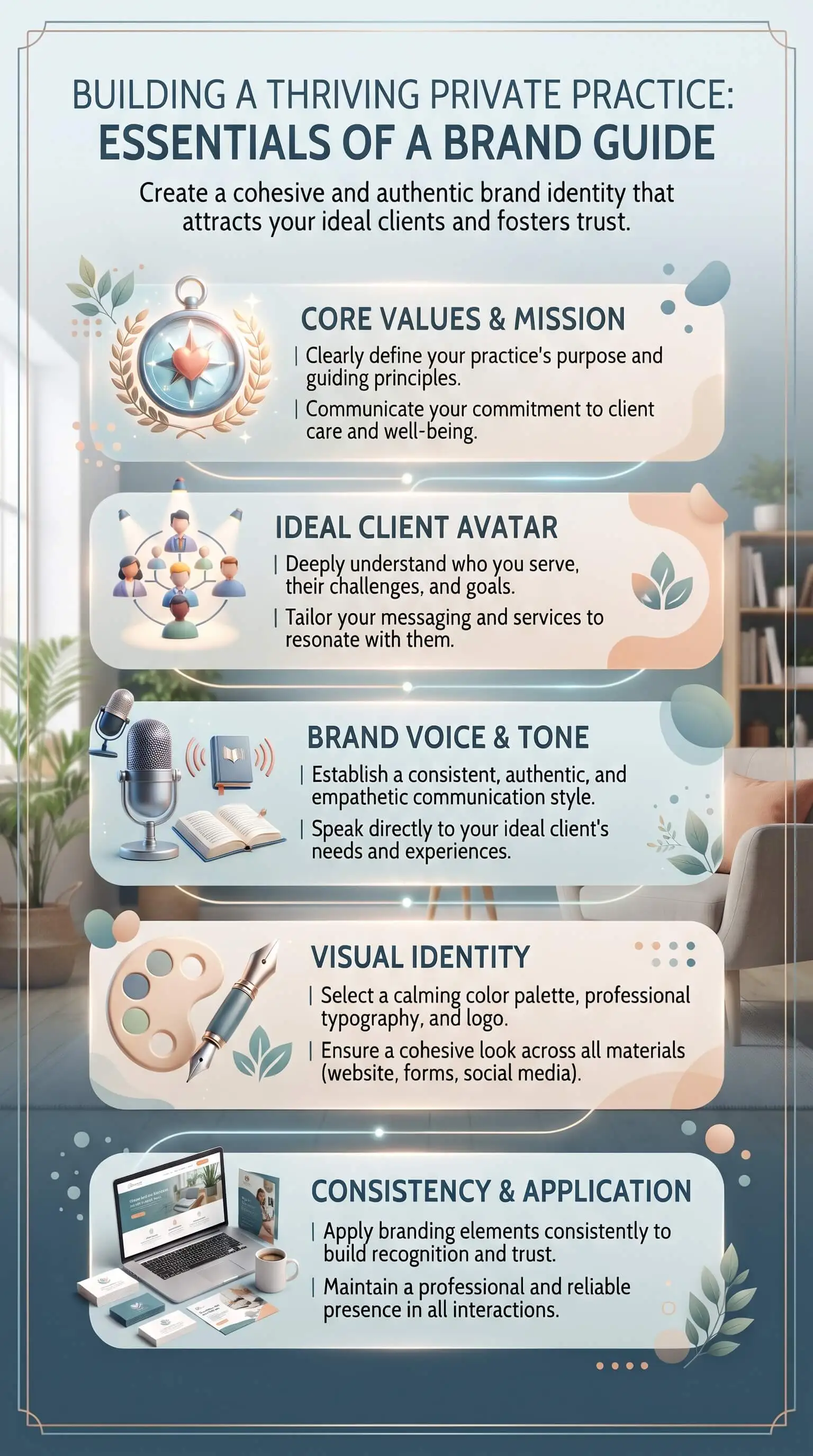
A private practice brand guide would have caught that before it was posted. It holds eight things: your positioning and ideal client, your mission and approach, your voice, a messaging library, your visual identity, channel rules, ethics guardrails, and who owns the guide. Write those down, and anyone who writes for your practice can sound like you, even on a day you're booked solid with clients.
I build these with therapists. The guides that actually get used are short and plain enough that somebody opens them every week.
TL;DR Quick Answers
Brand Marketing For Therapists
Brand marketing for therapists means showing the right clients who you help, how you work, and what you sound like before they ever book, and then saying it the same way everywhere they find you. It runs on four pieces:
Positioning: one sentence naming the person and the moment you help with, not a diagnosis.
Messaging: your clients' own words, like "can't stop worrying," in place of clinical terms.
Voice: a warm, steady tone that sounds the same on your website, directory profiles, and intake emails.
Ethics: no promised outcomes and no testimonials from current clients, so every claim holds up under your profession's code.
A short brand guide keeps those four consistent when someone else is writing for you. Calm, honest copy does more of the work than ads or SEO alone, since those only amplify the message you already have. This consistency also supports sustainability in marketing by building lasting trust rather than relying on constant promotion.
Top Takeaways
A brand guide writes down the brand you already have. Settle who you help and how you sound first, then put it on paper.
Words do most of the work. Your positioning and messaging library matter more to a nervous reader than your color palette.
Ethics belong inside the guide. A short list of lines nobody crosses keeps promised outcomes and solicited testimonials off your pages.
Consistency earns trust before the first session. Every place a client reads about you should sound like the same person.
A short guide people use beats a long one nobody opens. Two to five pages, reviewed yearly, will carry most practices.
What Is a Private Practice Brand Guide?
A private practice brand guide is a short reference that tells anyone writing for you how your practice should look and sound. Your logo file shows people where they've landed. The guide tells your assistant, your designer, and your next associate what to say once they're there.
That matters more in therapy than in most fields. People often reach out on a bad week, and they notice when your homepage sounds warm but your intake email reads like a parking ticket.
One caveat before you start. A guide writes down a brand you already have. If you're still working out who you help and how you want to come across, begin with the groundwork of brand marketing for therapists, then come back here. For the wider business case, this piece on why brand marketing is essential for your business is a good read.
The 8 Sections Every Therapist Brand Guide Needs
I put these eight sections in every therapist brand guide I write, and most of them fit on a single page.
1. Positioning Statement and Ideal Client
Start with one sentence that says who you help, with what, and why you. I use a simple fill-in: "I help [a person in a moment] who [struggles, in their words] through [your approach]."
Here's an illustrative one. "I help new parents who feel like strangers to each other find their way back to being a team."
Notice it describes a person and a moment, not a diagnosis. You'll still see other clients. The sentence just tells your writers who they're talking to.
2. Mission, Values, and Therapeutic Approach
Write your values as things a client can see you do. "Compassion" doesn't tell anyone much. "We reply to every inquiry within one business day, even when we're full" tells them plenty.
Describe your approach in client language too. "We look at the patterns that keep pulling you back into the same argument" lands better than a row of modality acronyms.
3. Brand Voice and Tone
Pick a handful of voice traits and give each one a guardrail. Mine for therapy practices often look like this:
Warm, not gushing
Steady, not clinical
Plain, not casual
Hopeful, without promising anything
Then jot down how the tone shifts by channel. Your homepage can be reassuring. A waitlist reply should be kind, brief, and clear about what happens next.
4. Messaging Library: Approved Phrases and Words to Avoid
Your team will open this section more than any other. Put your core promise here, plus a one-line description of the practice and your bio at 25, 75, and 150 words. Then add a short swap list:
Say "can't stop worrying," not "generalized anxiety disorder."
Say "you and your partner keep having the same fight," not "relational conflict patterns."
Say "we'll figure out where to start together," not "individualized treatment protocol."
Say "many people feel better over time," not "guaranteed results."
Say "a free 15-minute call," not "book now before spots run out!"
Add the clichés you're retiring while you're at it. "A safe, supportive space" tops my list, mostly because nearly every practice in town already says it.
5. Visual Identity: Logo, Colors, Fonts, and Photos
Keep this section short. List your logo versions and when each one gets used, your brand colors with hex codes, and two fonts, one for headings and one for body text.
Add a couple of photo rules while you're here. A real photo of you in your actual office beats the stock image of a sad person at a rainy window (we've all seen that one). Check your colors for readability as well, since soft pastels often fail contrast tests.
6. Channel Rules for Your Website, Directories, and Email
Write your practice name, credentials, and specialty one way, then use that version everywhere. A directory profile template and a standard email signature belong here.
If you practice in California, the Board of Behavioral Sciences spells out what your ads have to show, including your license number. Put those requirements in this section so nobody forgets them on a new listing.
7. Ethics and Compliance Guardrails
Give your team a short list of lines nobody crosses. Mine usually include:
Never promise a specific outcome or timeline
Never ask current clients for testimonials
Never share client details without written permission, even with names removed
Always list credentials accurately and in full
Every profession's code and every state board adds its own rules, so read yours and fold them in. Whether it's healthcare copy or a board game crowdfunding strategy, clear messaging still needs to follow the relevant guidelines. I'm a copywriter, not a compliance attorney. I'll flag the lines that look risky, and you and your board's rules make the final call.
8. Ownership, Access, and Review Schedule
Decide who approves changes and where the guide lives. One shared folder holding the guide, logo files, and fonts saves a surprising amount of hunting later.
Review it once a year. Also open it any time you add a service, change your rates, or bring on a new clinician.
How to Build Your Brand Guide in One Afternoon
You don't need a design agency for a working first draft. This is the order I'd follow:
Pull together what already exists: your website, directory profiles, intake emails, and any logo files.
Write your positioning sentence and a short paragraph about your ideal client.
Choose your voice traits and give each one a guardrail.
Write down ten phrases you actually say in session. They often turn into your best copy.
Lock in your logo, colors, and fonts.
Add your ethics guardrails and any board advertising rules.
Save it somewhere shared, date it, and send it to everyone who writes for you.
Group practices need one more step. Give every clinician the same bio template to fill in, so ten different people still sound like one practice. Bigger groups sometimes bring in a strategic branding agency to formalize this. Most solo therapists can start on their own.
Brand Guide Mistakes That Make Therapists Sound Like Everyone Else
In my work with therapy practices, the same problems come up over and over:
The guide is all visuals. It has colors and fonts and nothing about how you sound.
The bio leads with credentials. Your peers care about the letters after your name. A worried reader wants to know whether you get it.
There's no ethics section. That's usually how a promised outcome or a borrowed testimonial ends up on a page.
Nobody opens it. A 40-page PDF in a drawer is a guide in name only.
It never changes. Your practice grows, and the guide should keep up.
"Before I wrote a line of copy, I spent ten years in ministry, and the people who walked in on their worst days noticed everything. If the bulletin said one thing and the greeter said another, they felt it right away. Therapy clients do the same thing with your website, your directory profile, and your intake email. When all of it sounds like the same calm person, an anxious reader relaxes a little. I've come to think of consistency as a kind of safety, and a brand guide is how a practice keeps it."
7 Essential Resources
I keep these open while I draft a therapist's brand guide. I checked every link, and I've ordered them from the big picture down to the fine print.
1. Get Clear on What a Brand Actually Is
The American Marketing Association defines a brand as any distinctive name, term, design, or symbol that identifies a service. Your words count toward that as much as your logo does.
Source: American Marketing Association: Branding
2. Hear What a Therapy-Practice Designer Recommends
On this Practice of the Practice episode, designer Sam Carvalho lists a brand style guide as her fifth branding tip. Her version covers mission, ideal client, values, logo variations, fonts, and colors, all kept in one shared folder.
Source: Practice of the Practice: Sam Carvalho Gives 5 Tips on Branding Your Practice (FP 74)
3. Read California's Advertising Rules Before You Publish
The Board of Behavioral Sciences revised its advertising guide in March 2026, and the rules took effect April 1, 2026. Licensees need their name as filed, license number, and license title in their ads. Associates and trainees have a few extra requirements.
Source: California Board of Behavioral Sciences: Advertising Guide
4. Keep Counselor Credentials and Testimonials Honest
The NBCC Code of Ethics asks counselors to represent their credentials accurately. It also rules out asking current clients, or their family and friends, for testimonials. Both belong word for word in your guardrails section.
Source: National Board for Certified Counselors: Code of Ethics
5. Know the Federal Rules on Reviews and Endorsements
The FTC's plain-language Q&A covers reviews, endorsements, and incentives. It explains why tying a discount to a positive review can be deceptive, which is worth knowing before you ask colleagues or former clients to speak for you.
Source: Federal Trade Commission: FTC's Endorsement Guides, What People Are Asking
6. Use Your Real Practice Name on Google
Google wants your Business Profile name to match the name people see in the real world, without added taglines or service keywords. Copy that exact name into your channel rules.
Source: Google Business Profile Help: Guidelines for Representing Your Business
7. Make Sure Your Calming Colors Can Be Read
The W3C sets a minimum contrast ratio of 4.5:1 for normal text and 3:1 for large text. Run your palette through a contrast checker before it goes on business cards.
Source: W3C: Understanding Success Criterion 1.4.3, Contrast (Minimum)
Creating a trustworthy brand guide for your therapy practice means defining your brand identity, following advertising and ethical guidelines, using accurate credentials, and keeping your messaging consistent and accessible. These resources offer practical medical copywriting tips to help you communicate clearly, build client trust, and maintain a professional, compliant brand.
Supporting Statistics
I keep these three numbers in mind when a therapist asks whether a brand guide is worth an afternoon. None of them repeat the resources above.
1. Nearly Half of Psychologists Have No Openings
In the American Psychological Association's 2025 Practitioner Pulse Survey, 46% of practitioners reported no openings for new patients, and 40% kept a waitlist.
People who finally reach you may have tried a few practices first. A voice that stays the same from your homepage to your intake email gives them one less reason to keep looking.
Source: American Psychological Association: 2025 Practitioner Pulse Survey
2. The Field Keeps Getting More Crowded
The U.S. Bureau of Labor Statistics projects 18% employment growth for substance abuse, behavioral disorder, and mental health counselors from 2025 to 2035, with about 50,500 openings a year.
More practice means more websites that sound alike. A written guide keeps yours recognizable as the field fills in.
Source: U.S. Bureau of Labor Statistics: Occupational Outlook Handbook
3. 137 Million People Live in a Mental Health Shortage Area
The Health Resources and Services Administration counts about 137 million people, roughly 40% of the U.S. population, in Mental Health Professional Shortage Areas as of December 2, 2025. It also projects a shortage of 99,780 mental health counselors by 2038.
With that much unmet need, your brand's job is helping the right client recognize you quickly. Chasing more volume won't do that.
Source: HRSA: Behavioral Health Workforce Brief 2025
Final Thoughts and Opinion
Here's where I land. Most therapists don't need a 40-page brand book. They need a few pages they'll actually open.
The brand guides I see fail tend to be gorgeous. Somebody paid for a polished PDF full of mood boards, it went into a folder, and it never came back out. Meanwhile the assistant writing Instagram captions never saw it, and the new associate copied her bio from her last job.
The guides that work look a little plain by comparison. A positioning sentence, four lines on voice, a list of phrases to keep and phrases to drop, a short set of ethics rules. Someone updates them when the practice changes, and every new hire gets a copy on day one.
If you only finish one section this week, make it the messaging library. Your colors can wait. In private practice healthcare copywriting, the words you choose matter most. A worried person reading your site at midnight is deciding whether to call you based on the words, so those words should sound like you every time.
Frequently Asked Questions
Q: What should a private practice brand guide include?
A: Eight sections cover most practices: positioning and ideal client, mission and approach, voice and tone, a messaging library, visual identity, channel rules, ethics guardrails, and ownership with a review schedule. Start with the sections built on words, since they shape everything a client reads.
Q: Do solo therapists really need a brand guide?
A: Yes, though yours can be short. Even a one-person practice has a website, directory profiles, emails, and maybe an assistant or a designer. Two pages keeps all of that consistent and spares you from rewriting your bio every time someone asks for it.
Q: How long should a therapist brand guide be?
A: For most solo practices, two to five pages is plenty. Group practices may need a few more for bio templates and approval rules. If you can't skim it in ten minutes, the people who need it probably won't read it.
Q: What's the difference between a brand guide and a brand style guide?
A: People often use the two terms interchangeably. When they're split, a style guide usually covers visuals like logos, colors, and fonts, and a brand guide adds positioning, voice, and messaging. For a therapy practice, I'd keep both in one document.
Q: How does a brand guide support brand marketing for therapists?
A: Your marketing pulls from it. Every website page, directory listing, and email draws on the same positioning and voice, so clients get one clear picture of who you are. For the strategy behind that, read this therapist branding guide.
Q: Can I put client testimonials in my brand guide?
A: Usually not. Many ethics codes bar therapists from asking current clients for testimonials, and some limit former clients as well. Use the guide to list what can carry that trust instead, like a clear specialty, credentials in context, and a plain "what to expect" section.
Q: How often should I update my brand guide?
A: Review it at least once a year. Update it sooner when you add a service, change your rates, bring on a clinician, or your state board changes its advertising rules. Put a date on every version so everyone knows which one is current.
Q: Should my brand guide include my credentials and modalities?
A: Yes, written exactly the way your license and board require. Pair each one with a plain explanation, like "I use EMDR, a therapy that helps the brain process painful memories." The credential shows you're qualified, and the explanation tells a worried reader what that means for them.
Ready to Put Your Brand on Paper?
You already know how you sound in session. Your guide makes sure your website, listings, and emails sound that way too.
Block out one afternoon this week. Write your positioning sentence, pick your voice traits, and list ten phrases you say to clients all the time. That's a real first draft.
Still working out who you're for or how you want to come across? Start with the brand itself. My guide to therapist branding that builds trust before the first session walks you through it, one step at a time.


