Here’s the part nobody warns you about. You can spend a year balancing your TTRPG, playtesting it until your group is sick of it, and laying out a book you’re genuinely proud of… and a shopper on DriveThruRPG will scroll right past it in half a second. They never opened your game. They looked at your listing, thought “not for me,” and kept moving.
I’ve watched it happen to creators whose games deserved so much better. Brilliant design, invisible storefront. The good news is that the storefront is the easiest thing on this whole list to fix, and it’s the fastest way to sell more copies without spending another dollar on ads. So that’s what this guide is for. Think of it as DnD and TTRPG marketing at its most practical: choosing the right store, writing a title players actually find, building a description that turns a curious scroll into a sale, and getting your cover, filters, and pricing to pull their weight.
TL;DR Quick Answers
DnD and TTRPG Marketing
DnD and TTRPG marketing is the work of getting your tabletop role-playing game found, bought, and played by the players most likely to love it. What most creators miss is that tabletop RPGs sell adventure, not rules and mechanics: the late nights, the inside jokes, and the stories a group retells for years.
In practice, it comes down to three jobs:
Get found. SEO, social posts, and content put your game in front of players who don't know it exists yet.
Convert interest into sales. Your website, your storefront listing, and your Kickstarter page do the persuading.
Keep players at the table. Email, Discord, and community turn one-time buyers into a group that comes back.
Done well, it's how a solo creator competes with corporations and actual-play giants without matching their budget.
Top Takeaways
If you close this tab remembering only a handful of things, make it these.
Your listing makes the first sale, not your game. Fix the cover, the title, and the opening line before anything else.
Match the store to your product. DriveThruRPG for reach, DMs Guild for D&D audiences, itch.io for indie and experimental work.
Write literal, searchable titles that name the system and genre right up front.
Treat your metadata, filters, and tags as discovery tools, and keep every one of them accurate.
Listing optimization is just one practical corner of marketing as a whole craft, and the same fundamentals of audience, message, and clarity carry the day.
Pick Your Store Before You Touch Anything Else
Before you fuss over a single word, make sure your game is in the right shop. Each TTRPG marketplace draws a slightly different crowd, and the store you choose decides how much free discovery you get just for showing up.
DriveThruRPG is the big one. It pulls the most traffic, hands you the strongest promotion and recommendation tools, and supports print-on-demand. The catch is that you’re standing in a very crowded room, and the platform takes a larger cut than some of its rivals. DMs Guild runs on the same machinery, but it’s built specifically for Dungeons & Dragons content, and it lets you use official D&D settings and IP under its community agreement. If your game is made for D&D players, that ready-made audience is hard to walk away from.
itch.io plays by different rules. It welcomes indie work, lets you set part of the fee yourself, and its culture of game jams and bundles gives smaller or stranger projects a real shot at being found. Roll20’s marketplace and niche stores like Storyteller’s Vault cover virtual tabletop content and specific systems. And you don’t have to marry one platform. Cross-listing the same product across connected stores puts it in front of more buyers at once.
Write a Title That Actually Gets Found
Your listing title is doing two jobs at the same time. It tells a human what your game is, and it tells the marketplace’s search engine when to show your page. Most creators only ever think about the first job, and it costs them.
Lead with the system and the genre. Someone scanning a wall of search results should know in three or four words whether your product is for them. “Solo Journaling RPG of Deep-Space Salvage” tells them. “Echoes of the Void,” all on its own, tells them nothing, because no one searches for a name they’ve never heard.
Be literal about it. On-platform search often matches the words in the order you type them, so plain, specific wording gets found far more often than something clever. Use the words a buyer would actually reach for: the system, the format, the player count, the genre, the same approach strong board game copywriting services use when writing titles and product descriptions built to be searchable first and clever second. Keep your evocative subtitle, just put it after the part that does the searching. And clear out the clutter. Version numbers, your studio name, and a long tagline stuffed into the title shove the useful words off the edge of the screen, especially on a phone.
Build a Description That Closes the Sale
Once a shopper clicks, your description has a short window to answer their questions before they wander off. Open with the single best reason to care, then back it up.
Get the essentials fast: what the product is, which system it runs on, who it’s for, how long it is, and exactly what’s in the box. A game master choosing between your adventure and ten others wants the page count, the level range, and whether maps and handouts are included. Hide that, and you’ve handed the sale to someone else. Picture the description as a quick interview where the buyer asks the questions and you answer before they have to go digging.
Keep it easy on the eye. Short paragraphs, clear sections, and a strong first line beat a wall of text every time. Switch on product previews so buyers can see real pages before they pay, because a preview kills doubt better than any sales pitch I could write for you. One thing to plan around: DriveThruRPG only allows outside links from an approved list inside a product description, so decide early where your links live, make sure they support your overall brand strategy, and let the preview and the copy do the convincing.
Get Your Cover, Filters, and Price Pulling Weight
Three smaller levers quietly decide how often your listing gets seen and bought.
Your cover is the first thing anyone sees, almost always shrunk to a thumbnail. Make the title readable at that size, push the contrast, and let the art say the genre and tone at a glance. Fine detail that sings at full size turns to mush in a grid of search results. On itch.io, cover images use a 315 by 250 ratio, and uploading a bigger version at that same ratio, around 630 by 500, keeps it crisp.
Filters and metadata are pure discovery fuel. Set the right rule system, genre, and product type, fill your tags honestly, and complete the small fields like author and page count. Accurate metadata is what drops your product into the browse paths where the right people are already looking. If you used AI tools for your art, mark it where the platform asks you to.
For pricing, lean on the price points with a track record on your chosen store, use pay-what-you-want where it suits the title, and space your releases out. Drop five products on the same day and they’ll just fight each other for the same sliver of visibility. Steady, spaced-out releases also give returning shoppers a fresh reason to check your store again.
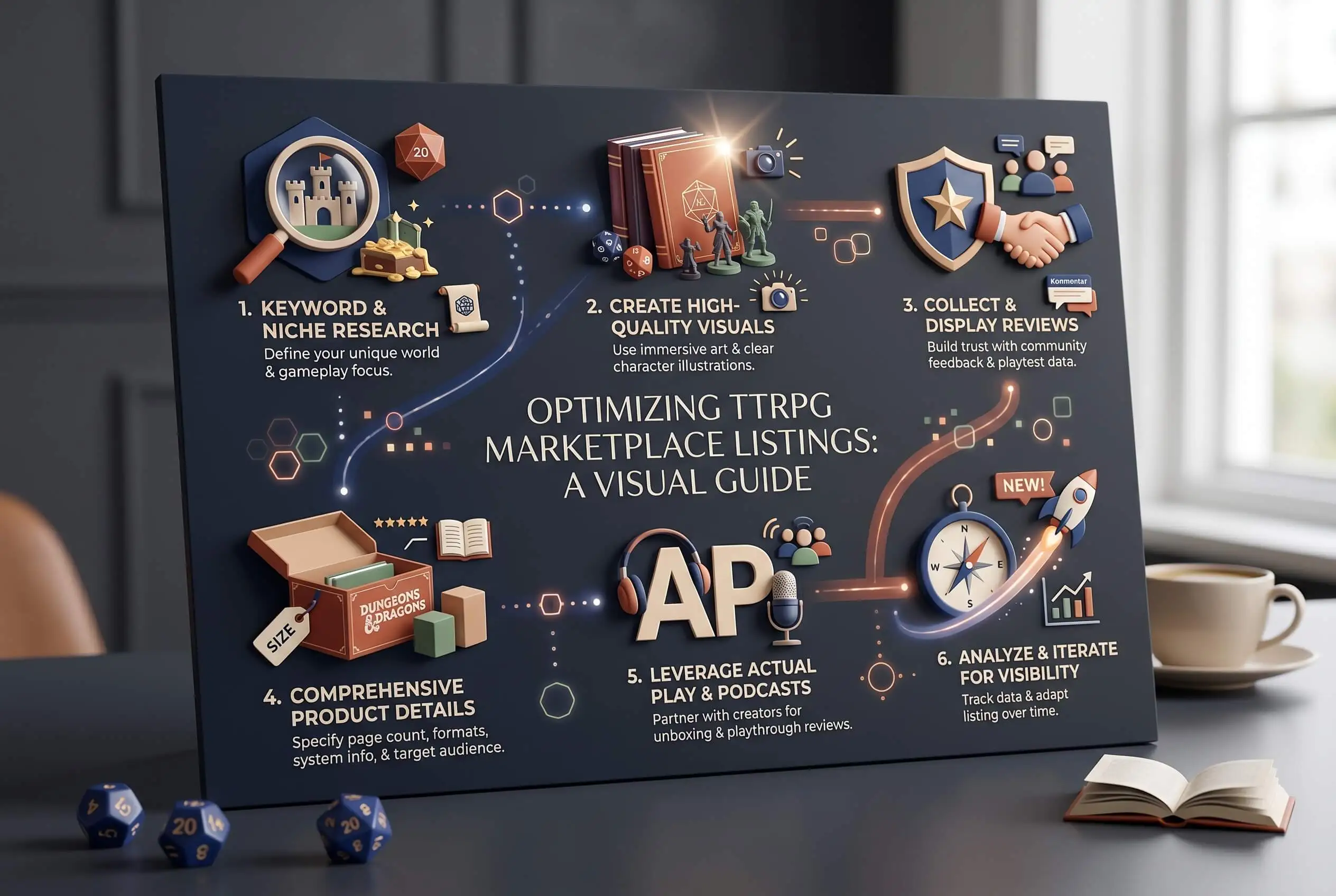
"When a shopper is browsing, nobody is judging your game on its quality yet. They’re judging one thumbnail, three or four words of title, and a single opening line. That’s the whole fight, and most creators lose it before anyone reads a word of their actual rules. So treat your listing like the NPC who takes the help action on your turn. It’s small, it’s easy to overlook, and it quietly hands you an advantage every single time someone lands on the page."
7 Essential Resources
Before you build or rebuild a listing, keep these open in a tab. Every one comes straight from a marketplace or from the wider tabletop industry, so you’re getting it from the source.
DriveThruRPG: Set Up a New Title or Edit a Title Listing. The official walkthrough for creating and editing a listing, including the fields that drive discovery.
DriveThruRPG: Product Standards Guidelines. Covers cover art, product previews, the right filters, and the disclosure DriveThru requires for AI-generated artwork.
DriveThruRPG: Digital Title FAQ. The price points that have performed best over time, plus guidance on spacing out your releases.
itch.io: Your First itch.io Page. itch.io’s own guide to cover image specs, titles, short descriptions, and classifying your project correctly.
itch.io: Content Creator Quality Guidelines. How itch.io’s discovery index works, and why honest, accurate tags decide whether you show up in it.
itch.io: Hosting a Sale or Bundle. A practical guide to running sales and bundles, both strong ways to get discovered and to lift revenue.
Roll20: Cross-Listing to DriveThruRPG and Supported Marketplaces. How to list one product across connected stores so it reaches more buyers.
Supporting Statistics
If you ever need proof that the tabletop audience is worth fighting for, here are three numbers I keep coming back to.
Brandon Sanderson’s Cosmere RPG raised more than $15.1 million from over 55,000 backers, which makes it the most-funded tabletop game in Kickstarter history. When the marketing and the presentation match the product, demand for TTRPG content gets enormous. Source: ICv2.
Gen Con 2024 sold out and pulled a record crowd of more than 71,000 attendees. The tabletop audience is large, it’s engaged, and it’s growing, and those are the same people scrolling marketplace listings tonight. Source: Gen Con.
2024 was the sixteenth straight year of growth for the hobby games channel, with roleplaying games among the categories driving the increase. The same industry analysts noted that publishers struggled to get noticed as new releases piled up, which is exactly the problem a sharp listing solves. Source: ICv2 hobby games market review.
Final Thought & Opinion
Here’s what I believe after years in this corner of the work: most creators put their effort in the wrong place. The game gets a year of love. The listing gets a rushed afternoon. But the listing is the cheapest, fastest lever you’ve got, and it’s the only part of your marketing still working at 2 a.m. while you sleep.
You don’t need a bigger budget to sell more copies. You need a cover that reads at thumbnail size, a title people can find, and a description that answers the questions a real buyer is asking. Treat your listing as something alive, not a form you filled in once. Come back to it every few months, test a fresh cover or a sharper opening line, and watch what the numbers do, which is the same kind of steady optimization a sustainability marketing agency uses when refining campaigns around long-term audience trust and visibility. The creators who win on these marketplaces aren’t always the strongest designers. Plenty of the time, they’re just the ones who refused to treat the storefront as an afterthought.
Frequently Asked Questions
What’s the best marketplace to sell a TTRPG?
There’s no single best one, only the best fit for your game. DriveThruRPG brings the most traffic and the strongest sales tools. DMs Guild is home for Dungeons & Dragons content and the audience is already shopping for it. itch.io suits indie, experimental, and small-format games. Plenty of creators list on more than one to widen the net.
How do I get my TTRPG noticed on DriveThruRPG?
Start with a cover that reads clearly as a thumbnail and a literal, searchable title. Fill in every filter and metadata field honestly, switch your previews on, and write a description that answers buyer questions in the first few lines. Then space your releases out instead of dropping everything at once.
Should I sell my D&D content on DMs Guild or DriveThruRPG?
If your product uses official Dungeons & Dragons settings or IP, DMs Guild is usually the right home, since its community agreement allows that content and its audience is already there to buy D&D material. For system-neutral or original-system games, DriveThruRPG gives you wider reach.
How much should I charge for an indie TTRPG PDF?
Price around the points with a track record on your chosen store rather than guessing at a number. Pay-what-you-want can build an audience for shorter or introductory titles. Whatever you land on, make sure the value of your description and preview promise actually matches the price.
Do listing thumbnails really affect TTRPG sales?
They really do. The thumbnail is the first thing, and sometimes the only thing, a shopper sees while scanning a grid of competitors. A cover that’s legible, high-contrast, and clear about its genre earns the click. One that turns to mush at small size gets scrolled straight past.
How do I market a TTRPG outside of marketplaces?
Show up where players already gather. Active communities on Reddit and Discord, a simple email list, regular social posts, and outreach to actual-play shows and reviewers all funnel traffic back to your listings. A page or site you own gives you a home base nobody else controls.
Your Move
You don’t have to rebuild everything tonight. Pick one listing, ideally your best seller or your most promising title, and run it through this guide. Check the cover at thumbnail size, rewrite the title so it’s literal and easy to find, and sharpen the first two lines of the description, the same way a freelance healthcare content writer refines copy to make complex topics instantly clear and searchable. Confirm every filter is right, and turn your previews on. Then watch your clicks and conversions for the next two weeks. Once you see what one well-optimized listing can do, work through the rest of your catalog the same way. Your game has waited long enough to be found.