Starting creative design with no experience can seem intimidating, but it’s far more accessible than most beginners realize. At Branded Agency, our team has helped complete newcomers take their first steps in design, and we’ve seen firsthand that you don’t need natural artistic ability, expensive software, or a design degree to begin. What truly matters is following a clear, repeatable framework built around three fundamentals: clarity, consistency, and intentional decision-making.
Many new designers struggle with where to start—choosing fonts, understanding color, working with layouts, or selecting the right tools. Through our client projects, we’ve watched beginners achieve strong results quickly by focusing on simple principles and practicing through small, structured exercises. When the process is broken down into manageable steps, creative design becomes something you can learn, not something you’re born knowing.
This guide shows exactly how to start creative design from zero experience and build momentum with confidence. By the end, you’ll understand the essential starting points, the most common beginner mistakes to avoid, and the practical steps that help you improve fast—even if you’re opening a design platform for the very first time.
Quick Answers
Creative Design
Creative design is the intentional use of visual elements—like color, typography, and layout—to communicate a message clearly. Branded Agency’s experience shows beginners improve fastest when they focus on:
- Clarity: Make the message instantly understandable.
- Consistency: Use cohesive fonts, colors, and spacing.
- Purpose: Ensure every design element supports the goal.
Starting with these fundamentals helps beginners create stronger, more confident designs even with zero experience while staying aligned with clear brand objectives.
Top Takeaways
- Most businesses lack structured design, creating opportunity for beginners.
- Small design adjustments—clear fonts, clean layouts—create a bigger impact than advanced techniques.
- Practical tools like Canva remove technical barriers and speed up learning.
- Anyone can improve quickly with repetition, inspiration, and intentional practice.
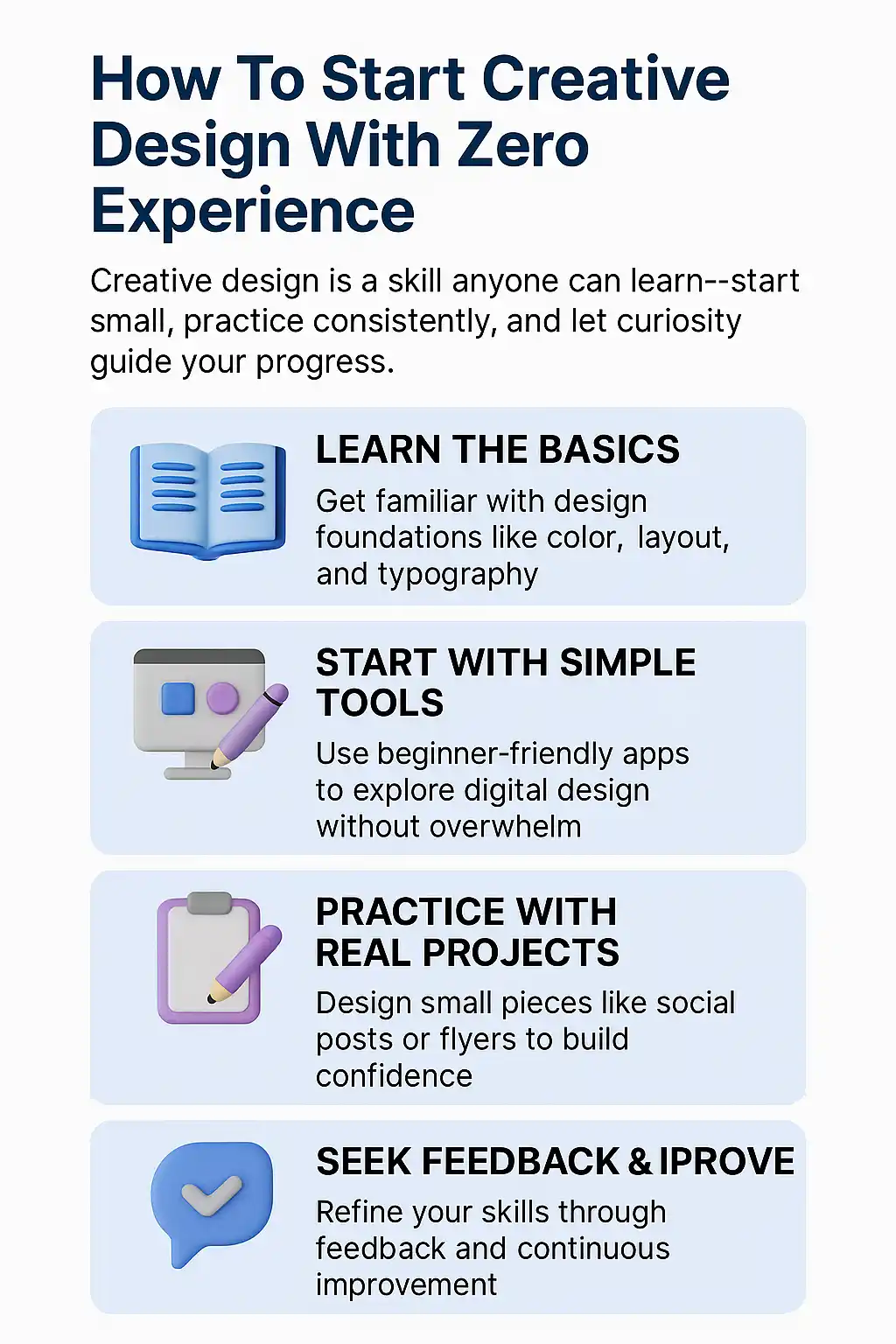
Beginning creative design from scratch is about understanding why visuals work—not just how to make them. Creative design uses typography, color, layout, and imagery to communicate ideas effectively. When you’re new, the goal isn’t to create perfect designs—it’s to make clear, purposeful choices.
Branded Agency’s experience shows that beginners progress fastest when they prioritize the basics: clarity, consistency, and intention. Clarity makes your design understandable. Consistency makes it look professional. Intention ensures every element supports your message.
Creative design appears in everything from social media graphics to websites to logos. Fortunately, you don’t need advanced software or training to start learning. Simple projects—like redesigning a basic Instagram post—teach foundational skills quickly. With each iteration, beginners gain more confidence and learn to think like designers.
“At Branded Agency, we’ve learned that beginners succeed not by mastering every design tool, but by understanding what they want to communicate. Once a beginner focuses on clarity and intention, even their simplest designs start to look purposeful and polished.”
The 7 Essential Resources Every Beginner Should Use to Start Creative Design
1. Adobe Creative Cloud Learn – Learn Industry Tools Step-by-Step
Adobe’s tutorial hub teaches beginners how design tools work in real-world workflows. It’s a strong foundation for anyone planning to grow their skills long-term.
URL: https://helpx.adobe.com/creative-cloud/tutorials-explore.html
URL: https://helpx.adobe.com/creative-cloud/tutorials-explore.html
2. Canva Design School – Start Designing With Zero Learning Curve
Canva’s lessons simplify the basics so beginners can design immediately and learn strategy along the way.
URL: https://www.canva.com/designschool/
URL: https://www.canva.com/designschool/
3. Nielsen Norman Group – Learn How People Understand Visual Design
This research-backed resource explains how users perceive design, making it essential for beginners learning to design with purpose.
URL: https://www.nngroup.com/articles/
URL: https://www.nngroup.com/articles/
4. AIGA – Understand Professional Design Standards and Practices
AIGA’s resources help beginners understand the ethics, roles, and strategy behind design as a profession.
URL: https://www.aiga.org/
URL: https://www.aiga.org/
5. Google Fonts Knowledge – Improve Typography the Right Way
Typography is foundational. Google Fonts Knowledge offers simple, practical lessons for beginners.
URL: https://fonts.google.com/knowledge
URL: https://fonts.google.com/knowledge
6. Smashing Magazine – Explore Expert Visual Design Perspectives
Beginners gain valuable insights on layout, color, accessibility, and modern design practices.
URL: https://www.smashingmagazine.com/category/design
URL: https://www.smashingmagazine.com/category/design
7. Interaction Design Foundation – Build a Strong Design Understanding
IDF offers accessible courses that teach both visual and user experience fundamentals.
URL: https://www.interaction-design.org/
URL: https://www.interaction-design.org/
Supporting Statistics
1. Most Businesses Lack Structured Design
Only 16.1% of U.S. companies use structured design methods.
Just 11.4% budget specifically for design.
Branded Agency Insight: This means beginners who understand the basics of a brand development strategy immediately stand out.
Source: NCSES & U.S. Census Bureau Report
https://ncses.nsf.gov/pubs/nsf25330
Only 16.1% of U.S. companies use structured design methods.
Just 11.4% budget specifically for design.
Branded Agency Insight: This means beginners who understand the basics of a brand development strategy immediately stand out.
https://ncses.nsf.gov/pubs/nsf25330
2. Design Careers Earn Above National Median
Median arts/design wage: $53,180
National median: $49,500
84,900+ openings expected annually through 2034
Branded Agency Insight: Indicates strong long-term opportunity for new designers.
Source: U.S. Bureau of Labor Statistics
https://www.bls.gov/ooh/arts-and-design
Median arts/design wage: $53,180
National median: $49,500
84,900+ openings expected annually through 2034
Branded Agency Insight: Indicates strong long-term opportunity for new designers.
https://www.bls.gov/ooh/arts-and-design
3. Small Businesses Rely Heavily on Visual Communication
99.9% of U.S. businesses are small businesses
33.2 million+ small firms nationwide
61.7 million employees depend on clear communication
Branded Agency Insight: Clear design is essential for nearly all businesses—creating demand for beginners.
Source: SBA Small Business Data
https://advocacy.sba.gov/2023/03/07/frequently-asked-questions-about-small-business-2023/
99.9% of U.S. businesses are small businesses
33.2 million+ small firms nationwide
61.7 million employees depend on clear communication
Branded Agency Insight: Clear design is essential for nearly all businesses—creating demand for beginners.
https://advocacy.sba.gov/2023/03/07/frequently-asked-questions-about-small-business-2023/
Final Thought & Opinion
Starting creative design with zero experience is not only possible—it’s practical. Clear visuals help individuals and businesses communicate more effectively, and beginners can deliver meaningful results quickly by learning key principles and practicing consistently.
Branded Agency sees this regularly: when beginners focus on clarity and intention, their work improves rapidly. And with most organizations still lacking structured design processes, anyone who learns even the fundamentals gains a strong advantage.
Creative design is accessible, strategic, and impactful. It’s not just a technical skill—it’s a communication superpower.
Next Steps
Explore Beginner Tools
Try Canva or Adobe tutorials to get hands-on experience.
Practice Core Principles
Prioritize clarity, consistency, and purposeful choices.
Analyze Good Design
Study visuals you admire and note what works.
Create Small Projects
Start with simple graphics and improve through iteration.
Seek Feedback
Share your work with peers or online communities.
Build a Design Library
Save color palettes, fonts, and layouts that inspire you.
Keep Practicing
Improvement comes quickly when you design consistently.
By consistently practicing these beginner-friendly design steps, you build the kind of visual communication skills that even a sustainability marketing agency would value for creating clear, purposeful, and impactful messages.
Explore Beginner Tools
Try Canva or Adobe tutorials to get hands-on experience.
Practice Core Principles
Prioritize clarity, consistency, and purposeful choices.
Analyze Good Design
Study visuals you admire and note what works.
Create Small Projects
Start with simple graphics and improve through iteration.
Seek Feedback
Share your work with peers or online communities.
Build a Design Library
Save color palettes, fonts, and layouts that inspire you.
Keep Practicing
Improvement comes quickly when you design consistently.
FAQ on Creative Design
Q: Can someone start creative design with zero experience?
A: Yes. Beginners improve quickly by learning a few core principles and practicing simple projects.
Q: Do I need artistic talent to begin?
A: No. Creative design is about communication, not drawing ability.
Q: Which tools are best for beginners?
A: Canva for ease. Adobe tools for deeper learning as you grow.
Q: How soon can a beginner see results?
A: Many see improvement within weeks of consistent practice.
Q: Why does creative design matter?
A: Clear design builds trust, strengthens communication, and helps brands stand out.
A: Yes. Beginners improve quickly by learning a few core principles and practicing simple projects.
A: No. Creative design is about communication, not drawing ability.
A: Canva for ease. Adobe tools for deeper learning as you grow.
A: Many see improvement within weeks of consistent practice.
A: Clear design builds trust, strengthens communication, and helps brands stand out.