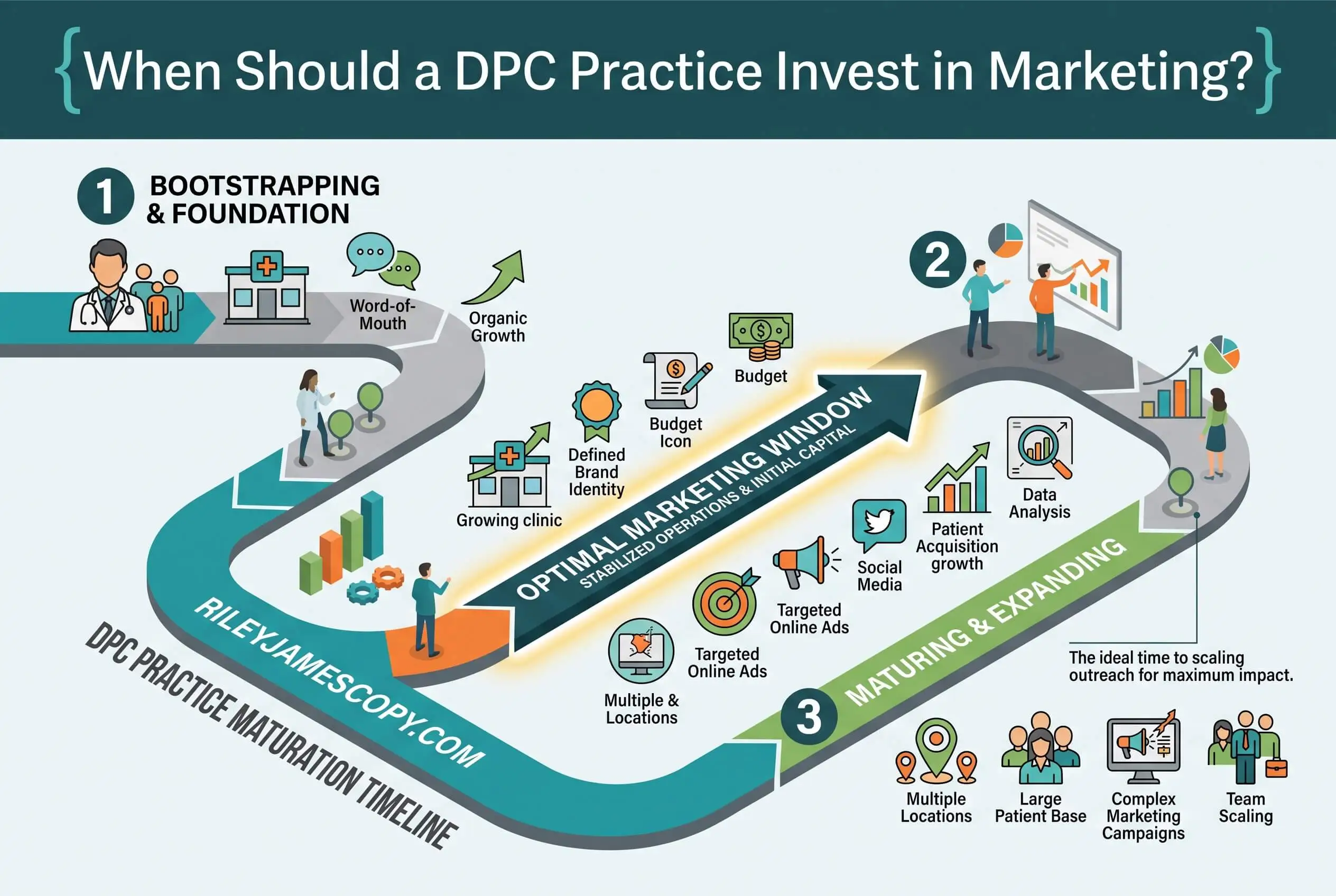
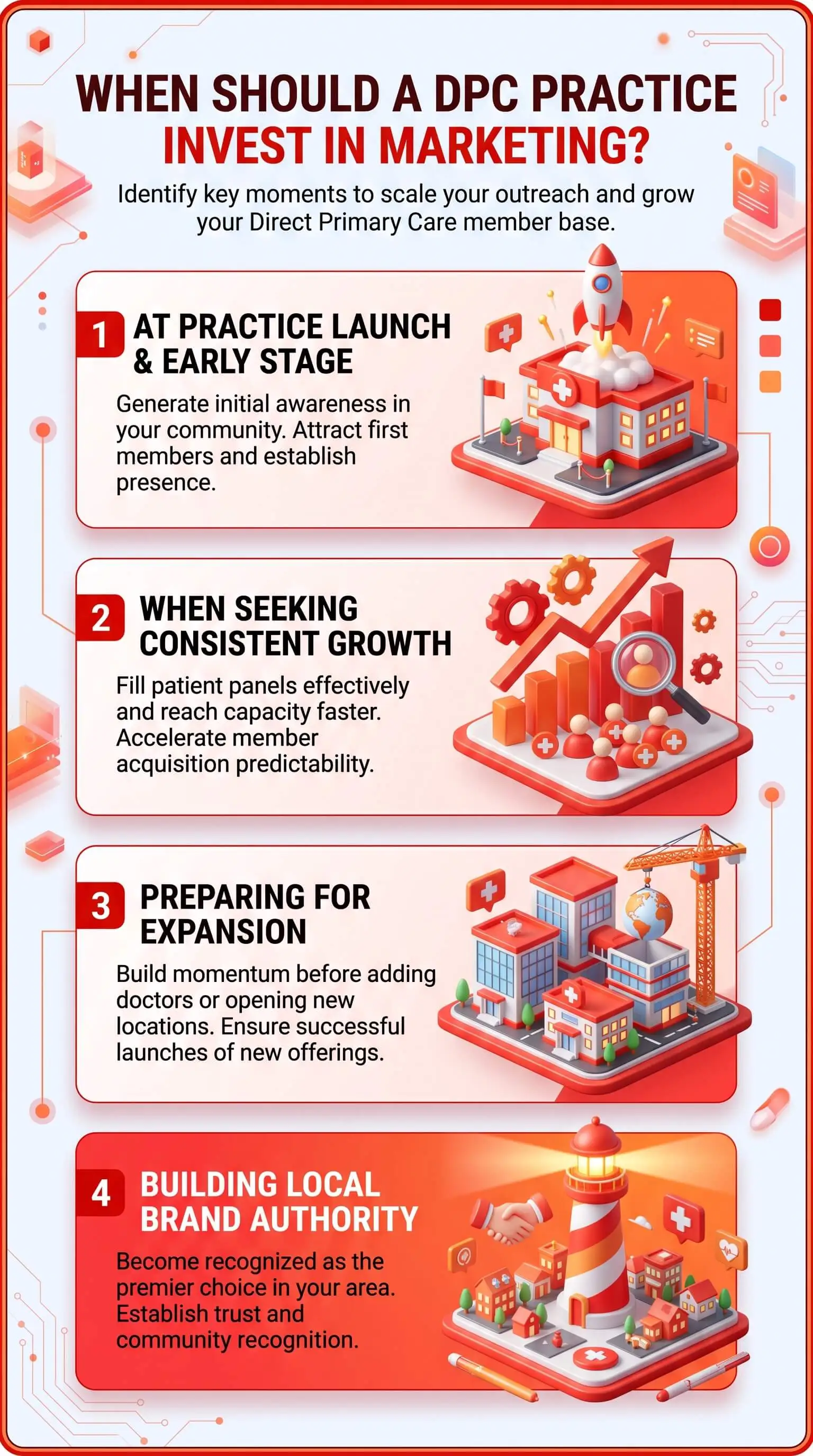
Marketing has no right moment on the calendar. Your practice is ready when three things line up: you can explain your membership in one sentence, your panel has room, and referrals have stopped filling it. Miss any one of those and spending money won't fix what's actually wrong. It'll just make the wrong thing louder.
Most doctors ask me this a few months into a slow stretch, once the worry has set in. That's usually the wrong moment to hire anybody, and a good moment to find out whether you're ready.
TL;DR Quick Answers
Physician Marketing Help
Physician marketing help means outside support for filling a practice: website copy, local search, reviews, and patient email. Most physicians who ask for it need one page rewritten, not a twelve-month retainer.
Hire when the diagnosis is already clear and execution is the bottleneck. If you're still deciding what the practice is, no writer can settle that for you.
Right first hire: whoever fixes the page people already land on
Wrong first hire: anyone selling reach before your site converts
DPC Physician Marketing
DPC physician marketing covers the narrow set of work that fills and keeps a direct primary care panel: your membership page, local search, reviews, and email to current members. The model changes the math. You're selling a renewal, so two patients who stay five years beat twenty who book once.
That's why volume tactics misfire here. With an average DPC panel near 402 patients, according to the AAFP, you need a few hundred of the right people. It's a marketing problem you can actually finish.
Top Takeaways
Readiness beats urgency. A slow month isn't a signal to spend. A clear offer, an open panel, and a referral plateau are.
Capacity comes first. If you can't absorb ten new members this quarter, you've got a capacity problem, not a marketing one.
Fix the website before you buy traffic. Paying to send strangers to a page that leaks is paying to lose them faster.
A referral plateau is the real trigger. Three flat months of net new members means word of mouth has done its part and something else has to carry the load.
Organic compounds. Ads reset. A membership model rewards work that builds month over month, which is why sequence matters more than budget.
What “Investing in Marketing” Actually Means Here
Direct primary care sells a membership. That one fact rewrites the whole job.
An insurance-based clinic can win on volume. Push enough people through the door and the billing sorts itself out. You can't do that, and you wouldn't want to. You need members who join and stay, which means two patients who renew for five years matter more to you than twenty who book once and vanish.
So when I say dpc physician marketing, I'm talking about a narrow slice of work: the website, local search, reviews, and the emails that keep the members you already earned. It doesn't include brand awareness or reach, because a full panel is the only number that counts.
Marketing as a field is enormous, and almost none of it applies to a solo practice with four hundred open slots. Ignoring most of it is how you get further, faster.
Three Signs You're Ready
1. You Can Explain Your Membership in One Sentence
If you can't, marketing broadcasts the confusion at scale.
How to tell: ask whoever answers your phone to explain membership to you, as though you'd called in cold. If their answer and yours don't match, fix that before anything else. It costs you nothing but a phone call, and nothing else on this page comes that cheap.
2. Your Panel Has Room for the People You're About to Ask For
A DPC panel has a ceiling by design. You already know why you built it that way.
Marketing into a full panel buys you a waitlist, annoyed callers, and one-star reviews from people who never became patients.
How to tell: how many members could you add this quarter without your appointments getting shorter? If the answer is under ten, you've got a capacity problem wearing a marketing costume.
3. Referrals Have Plateaued
Almost every DPC practice grows on word of mouth first, and it keeps working right up until you reach the edge of your existing network, which is usually smaller than it feels from the inside.
That plateau is the trigger. Not opening day.
How to tell: chart net new members per month across your last six months. Three flat or falling months in a row means referral has done what referral does on its own. Which is oddly good news. It means you built something people talked about.
Four Signs You Should Wait
I turn work down over these, and not out of nobility. A physician who wastes a budget on my advice doesn't come back, and I'd rather have the second project than the first.
Your website can't convert the traffic you've already got.
Open your analytics. If people land on your DPC page and leave without calling, more visitors won't help. Buying traffic for a page that leaks is paying to lose people faster.
Members are leaving and you can't say why.
Marketing accelerates whatever your practice already does. If retention is slipping and the cause is still a mystery, new members will churn out through the same gap the last ones did. Find the leak first. Then fill the funnel.
You haven't named a number you're willing to lose.
Pick a figure and a window before you start. Without both, you can't tell the difference between marketing that failed and marketing that hasn't finished yet. Ninety days is about the shortest honest window for organic work.
You're still deciding what kind of practice this is.
Adding a provider, or weighing a hybrid model? Maybe you're thinking about pediatrics, or a second location that would change who you're even talking to. Land that decision first. A practice in the middle of becoming something else produces messaging that's in the middle of becoming something else, and that converts nobody. The copy gets better and cheaper on the other side of the decision.
If you're in this group and somebody's pitching you a retainer anyway, read up on what a good marketing agency actually does before you sign anything.
What to Do First When You're Ready
The order matters more than the budget does.
Fix the website. Your DPC page makes your pitch whether you wrote it well or not. It should answer a worried person's questions before they have to ask them out loud: what do I get, what does it cost, what happens if I need a specialist, how do I start.
Claim local search. Somebody typing “direct primary care near me” has already decided to act. A clean Google Business Profile and one sharp local page put you in front of them, and neither one costs money.
Make reviews and email routine. Once the site converts, your service keeps people, and their reviews bring the next ones. Email is how you hold onto members you already paid to earn.
Organic usually beats ad spend for a DPC practice, and the reason is structural. A membership model rewards work that compounds month over month. An ad budget resets to zero the day you stop paying. Ads have their place, opening a second location or covering a specific gap, but they're a poor first move for a practice still filling its first panel.
For the longer version of this sequence, along with how I scope it, there's detailed guidance on physician marketing help and DPC physician marketing for DPC practices laid out in full.
What It Costs, Roughly
Two honest things about price.
Scope drives cost, not channel. One well-built membership page is a different project from a full site rebuild, and both differ from ongoing content. Ask for the number before you sign. Anyone who won't give you one before the work starts is telling you something.
Buy the next right piece, not a retainer you can't evaluate. A solo practice with a leaking website doesn't need twelve months of social media. It needs one page rewritten. Firms price all over the map, and there's a general breakdown of what marketing firms cost if you want the range. For a DPC practice, small and specific beats broad and monthly nearly every time.
“Here's what turning work down has taught me. The practices that call too early aren't short on marketing, they're short on a decision. They haven't settled the membership price, or they're two months from adding a provider, or they're quietly hoping I'll tell them the website is fine. It usually isn't. And no amount of good copy fixes a practice that hasn't finished becoming itself.”
7 Essential Resources
Seven things worth reading while you decide. I checked every link against the source. Skim the ones that match your moment.
1. Get the Model Itself Straight
Before you market direct primary care, be able to describe it the way your own professional body does. The AAFP covers the membership structure, what a fee usually includes, and where DPC parts ways with concierge care. Borrow the language for your own page.
Source: American Academy of Family Physicians
2. See How Crowded Your Area Already Is
Search your ZIP code on the DPC Frontier mapper. Three practices within ten miles of you means referral plateaus sooner and your website has to work harder. If you're the only one, your job is teaching your town what the model is, not beating a competitor at it.
Source: DPC Frontier Practice Mapper
3. Set the Budget Before You Set the Strategy
The federal small-business walkthrough for building a marketing plan and tying spend to return. Unglamorous and free, and it forces the one decision most practices skip: what you're willing to spend, and how you'll know it worked.
Source: U.S. Small Business Administration
4. Know What You're Allowed to Claim
Health claims sit under a higher bar than most advertising, and “truthful and substantiated” has a specific legal meaning. Read this before you write a headline that promises an outcome, so your copy never writes a check your evidence can't cash.
Source: Federal Trade Commission
5. Use Patient Stories Without Breaking HIPAA
Testimonials work, and they carry real risk. This is the federal guidance on when patient information can appear in marketing and when written authorization has to come first. Read it before a happy member's story goes anywhere near your homepage.
Source: U.S. Department of Health and Human Services
6. Claim the Free Listing Before You Buy Anything
A verified Google Business Profile is the highest-return free step in local healthcare marketing. If you never claimed yours, never verified it, or it still shows the hours you kept two years ago, fix that this week and postpone every paid decision until you do.
Source: Google Business Profile Help
7. Get a Second Opinion at No Cost
If you've decided you're not ready to spend, this one's for you. SCORE pairs small-business owners with volunteer mentors, free, nationwide. Your practice is a small business, and an outside read on your plan costs you an hour.
Source: SCORE
Supporting Statistics
Three numbers worth knowing before your next marketing decision. All three come from a professional association, a university research team, or federally hosted research, and none of them repeat the resources above.
1. Recruiting Members Is a Top-Two Worry, and the Target Is Smaller Than You'd Think
The AAFP puts the average DPC panel at roughly 402 patients, and names capital or cash flow and patient recruitment as the two leading concerns for physicians opening a practice.
The read: you're after a few hundred of the right people, not a flood. That's a marketing problem you can actually finish, and it's why precision beats volume for a practice your size.
Source: American Academy of Family Physicians
2. Membership Practices Nearly Doubled in Five Years
A Johns Hopkins-led study published in Health Affairs found concierge and direct primary care practice sites grew from 1,658 in 2018 to 3,036 in 2023, an increase of 83.1%. Clinicians working in them rose from 3,935 to 7,021 over the same stretch.
Why your referrals slowed: it's rarely that the practice got worse. Your patients now have somewhere else to go.
Source: Johns Hopkins Carey Business School
3. Nearly Six in Ten Patients Weigh What They Find Online
Research hosted by the National Institutes of Health reports that close to 60% of U.S. respondents say online information and physician reviews matter somewhat or very much when they're choosing a doctor. Even the patient your neighbor sent looks you up before calling. Your website isn't competing with word of mouth. It's the last step of it.
Source: National Institutes of Health (PMC)
These statistics show why clear messaging and sustainable patient growth matter, and a freelance healthcare content writer can help turn those insights into content that attracts, educates, and retains the right members.
Final Thought & Opinion
Short version. Marketing's ready for you when the offer is clear, the panel has room, and referrals have gone quiet. It isn't ready when your website leaks, your members are drifting off, you haven't set a budget, or you're still deciding what the practice is. When you do start: website, then local search, then reviews and email.
Now the part I'll actually argue for.
Most DPC practices start marketing about six months late, and in the wrong order once they finally do. They wait until a slow quarter scares them, then buy the most visible thing on the menu, usually ads, because it feels like action. Meanwhile the page that would have converted the traffic they already had sits untouched for another year.
The cheapest month of marketing you'll ever run is the month you spend fixing your own website. There's no media cost. It compounds, and it makes every dollar you spend afterward work harder than it otherwise would have. Almost nobody wants to hear that, because it isn't exciting and it doesn't produce a dashboard.
You probably don't need an agency or a five-figure ad budget. What you need is a clear page, a handful of local search terms your future members actually type, and an email that keeps the people you've already earned.
That's the list.
Frequently Asked Questions
How do I know if my DPC practice is ready for marketing?
Three tests. You can explain membership and its price in one sentence. You could add at least ten members this quarter without shortening appointments. And your net new members have run flat or fallen for three straight months. All three true means start. Any one missing means fix that first.
Should a new DPC practice market before it opens?
Yes, but narrowly. Pre-launch, the work is a clear website, a claimed and verified Google Business Profile, and some way for interested people to join a list. Skip paid advertising until you can actually enroll members. Interest you can't convert is interest you lose.
How much should a DPC practice budget for marketing?
There's no single right figure, and scope moves the number more than channel does. What matters is naming an amount and a window before you start, because ninety days is about the shortest honest window for organic work. Without both, you can't tell failure apart from work that isn't finished.
Is SEO or paid advertising better for direct primary care?
Organic search wins over time for most DPC practices. Membership rewards work that compounds, and rankings and content keep building after you stop paying, while ads stop the day the card does. Use ads to cover a specific gap or launch a second location, not to fill a first panel.
When should a DPC practice hire outside physician marketing help?
Hire when the diagnosis is clear and execution is the bottleneck. You know the page is the problem, and you don't have the hours or the training to rewrite it. Don't hire somebody to make the decision for you. Get physician marketing help after you've run the readiness test, not instead of running it.
Call to Action
Run the Test Before You Spend
Give it five minutes. Say your membership out loud in one sentence, count the open slots on your panel, then chart your last six months of net new members and look at the shape of the line. If the picture still isn't clear, medical healthcare copywriting services can help turn that story into messaging patients immediately understand.
Three greens and you're ready. Start with the website.
One red and you just saved yourself a budget, which is a better outcome than most marketing decisions produce.