Here's the part most Gamefound guides won't say out loud: a campaign that hits 100% of goal can still bankrupt the publisher who ran it. I've watched it happen on three different campaigns in the last eighteen months. Six months of work, four grand in ads, 1,800 backers, and the creator is in the red by Thanksgiving because the public funding goal was set 40% below true break-even. The campaign technically succeeded. The publisher quit. Funded-but-failed is the small publisher's most common outcome on Gamefound, and almost nobody talks about it.
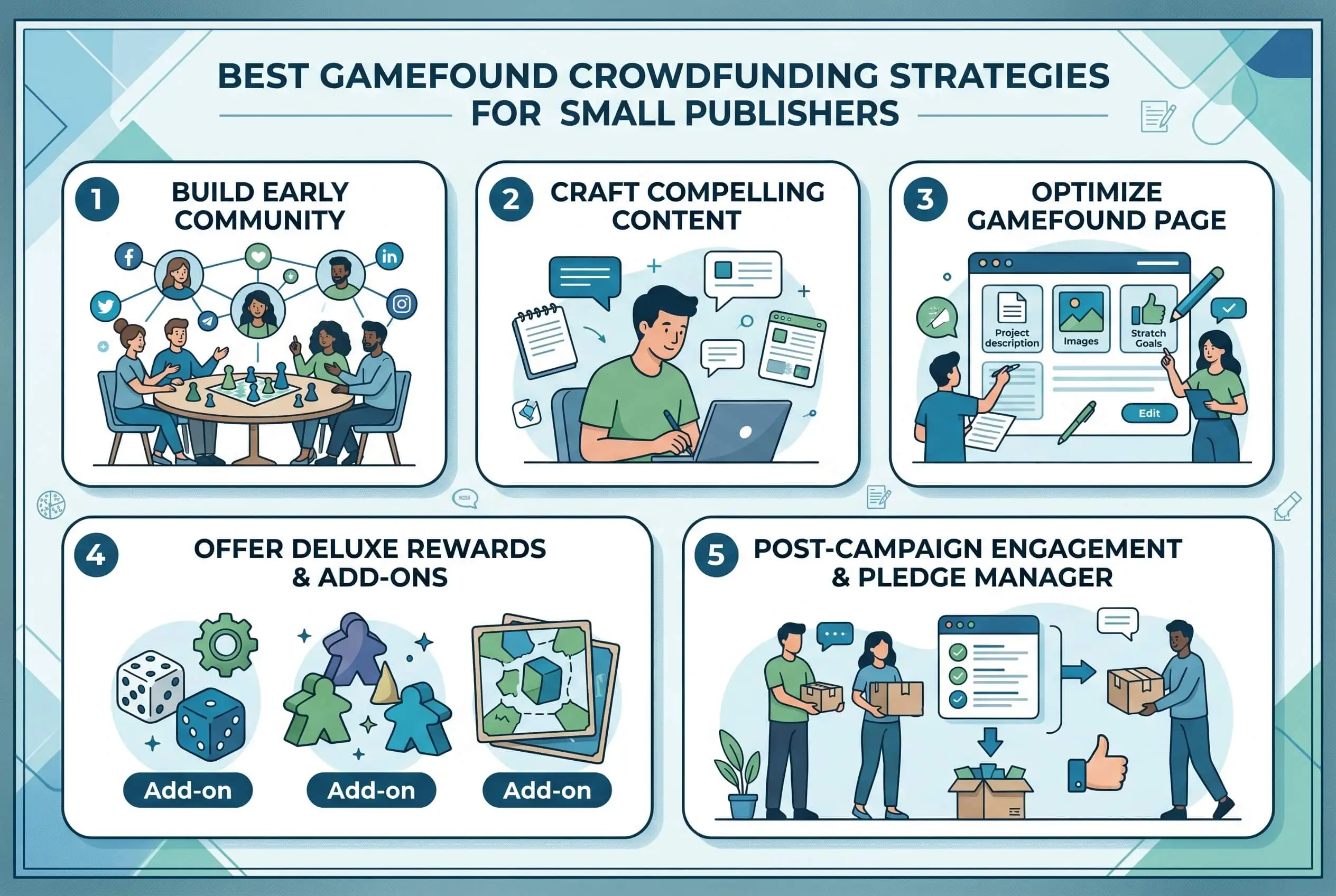
So let's actually talk about it. This guide is for the solo studio, the one-person designer-publisher, the first-timer wondering whether 4,000 followers is enough and whether to pick Gamefound or Kickstarter. A board game crowdfunding strategy isn't a single tactic. It's a sequence of decisions made across a six-month runway that pays off in the first 48 hours of your launch. The tactics below are what consistently works for the small publishers we work alongside. And what consistently sinks the ones who skip them.
TL;DR Quick Answers
board game crowdfunding strategy
A board game crowdfunding strategy is the four-to-six month sequence of decisions a publisher makes before the campaign goes live, not the launch itself. The strongest small-publisher campaigns on Gamefound and Kickstarter succeed because the pre-launch work was already done by the time the project page went public.
A working strategy includes:
A pre-launch project page opened 4 to 6 months ahead of launch, populated with art reveals, prototype clips, and designer diary content
A follower target of one follower per $5 to $10 of your funding goal
A public funding goal set at roughly 60% of your true break-even number, not your minimum producible cost
At least one third-party review or preview from a respected channel (Watch It Played, Quackalope, No Pun Included)
A day-one email sequence sent 4 to 6 hours before launch, at launch, and again at the 24-hour mark
A planned 48-hour closing push to capture late deciders
The campaign launches successfully because the strategy already did its job. Done right, launch day is the easy part.
Top Takeaways
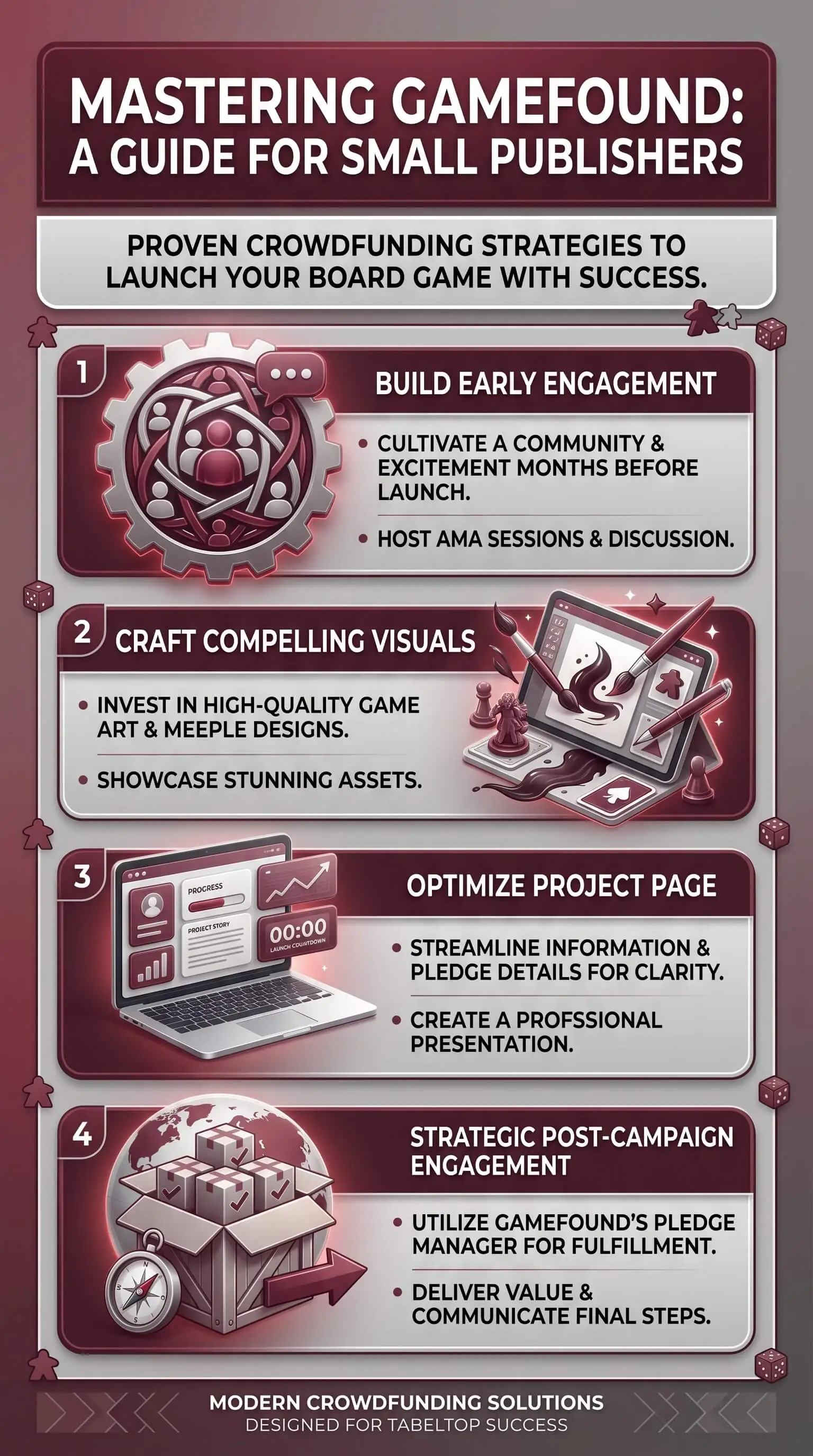
Gamefound campaigns are won or lost in the four to six months before launch, not on launch day itself.
Follower count is the leading indicator of funding outcomes. Realistic target: one follower for every five to ten dollars of your funding goal.
Your minimum funding goal and your true break-even are not the same number. Confusing them is the most common small-publisher failure mode we see.
The modern board game category has expanded dramatically over the last fifteen years. The audience for a tabletop board game now spans casual gateway titles, hobbyist strategy releases, and licensed-IP collector editions, which means small publishers have a real path to find their specific corner of the market.
A single review video from a respected third-party reviewer outperforms a month of paid social ads for trust-building on a first campaign.
Pledge manager and late pledge volume can add 30 to 50% to your campaign total when you plan for them rather than phoning them in.
Update cadence during the live campaign is a momentum tool, not a courtesy. Two updates per week is a workable floor.
Why Gamefound Works Differently for Small Publishers
Gamefound was built for tabletop. Kickstarter wasn't. That's the whole thing right there. When your traffic shows up on a tabletop-native platform, those visitors already know what a meeple is and which side of the box tells them the player count. You don't have to teach them anything before they decide whether to come back. Lower platform fees keep more money in your fulfillment budget. The pledge manager is built in, which means you skip the post-campaign migration that's eaten the launch high out of more publishers than I can count. In 2024, Gamefound became the biggest crowdfunding platform for board games by combined funding. The platform's own growth is doing some of your traffic work for you, which is the closest thing to a tailwind you get in this industry.
Build Your Pre-Launch Page 4 to 6 Months Out
Your pre-launch page is the work. Open it the day you decide this game is real. From that day to launch, you're posting art reveals, prototype clips, designer diary entries, and behind-the-scenes process work. The goal is followers, and I mean followers on the project page itself, not your personal Twitter count. Here's the math I use with first-timers: aim for one follower for every five to ten dollars of your funding goal. A $30,000 goal points to a follower target somewhere between 3,000 and 5,000. Below 1,000 followers at launch, your day-one looks flat, your social proof never kicks in, and the algorithm de-prioritizes you. Use the follower-gift feature — a free promo card, an exclusive add-on, a discount tier — to give followers a reason to actually click the button instead of lurking.
Define a Realistic Funding Goal You Can Actually Hit
Two numbers. They're different. Stop confusing them. Your public funding goal is the lowest number you can legally hit and still produce the game. Your true break-even is what it actually costs to make, ship, fulfill, pay platform fees, and pay yourself for the year it'll take to deliver. The first is usually 50 to 70% of the second. Here's the trap: you fund at 100% of your low public goal, you celebrate, and you've actually funded at 60% of break-even. Congratulations, you just signed up to lose money for nine months. Run the math against your manufacturer's MOQ. Get current freight quotes, not 2022 freight quotes, for your container size. Add the per-backer fulfillment fee from your regional partner. If the numbers don't pencil out at your projected pledge volume, raise the price, cut a component, or wait six months until they do as part of smarter brand strategy development before launch.
Earn Backer Trust Before You Ask for Money
Backers on Gamefound have funded campaigns that died in production. They're cautious now. The publishers who consistently fund well share three things and you can see all three on their project page in 30 seconds: a designer with a face and a real name, a working prototype on video being played by actual humans, and at least one third-party review or preview before launch. Reach out to the reviewers three or four months ahead, not three weeks. Watch It Played, Quackalope, and No Pun Included are the obvious starting points. Send a sleeved prototype, a one-page sell sheet, and a clear ask. A single 12-minute video from a respected channel will do more for your trust signal than two thousand dollars of paid Meta ads. I've watched that play out on three different small-publisher campaigns this year.
Use Gamefound's Native Tools the Right Way
Three platform tools earn their keep for small publishers. First: the late pledge phase. Treated correctly, late pledges add 30 to 50% on top of your campaign total. Most creators leave it on autopilot and add maybe 10%. Second: the pledge manager. You collect addresses, upsell add-ons, and adjust for manufacturing reality without having to rerun anything. Third: AdFound, the managed Meta ad tool the platform launched in 2025. It's not magic. But it brings your follower acquisition cost down meaningfully if you've never run paid social before. Now, the tool nobody treats as a tool: update cadence. Publishing two updates per week during the live campaign keeps your project showing up in followers' inboxes and tells undecided backers you're reliable. The publishers who go quiet for nine days mid-campaign are the same publishers who post explanation videos in March 2026 about why fulfillment is late. Don't be those publishers.
Plan the First 48 Hours and the Final 48 Hours
Day one is the biggest traffic day you'll ever get on your campaign. Funded-on-day-one is a social proof signal that pulls in followers who were waiting to see if anyone else would jump first. Email your list four to six hours before launch, again at launch, and again at the 24-hour mark. Don't be cute about the cadence. Set an early-bird tier that expires inside 72 hours so the price-sensitive backers commit fast. The final 48 hours work the same way in reverse. A clear closing-soon email. One last social proof update with total backers and goal percentage. A push to followers who haven't pledged yet. That closing sequence routinely adds 10 to 20% to a campaign total. The publishers who skip it are the same ones who later wonder why their campaign ended at 142% instead of 165%.
Convert Followers Into Pledges with a Layered Funnel
Followers don't convert because they're nice people. They convert because you've given them five different reasons that fit five different motivations. Early-bird pricing rewards the impatient. Stretch goals reward the patient. Retailer pledge tiers bring in your FLGS at wholesale. Referral incentives give your loudest backers a reason to actually share the campaign. Ambassador programs give you a small unpaid army who'll evangelize your project for a free copy. Run all five in parallel, not sequence. The campaigns that fund cleanly treat the backer list as five separate audiences, not one homogeneous blob marked "backers."
"The most dangerous outcome for a small publisher isn't a failed campaign. It's a campaign that funds at 102% of goal and quietly loses money for nine months while you fulfill it. I've watched that scenario end more first-time studios than failed launches ever have."
7 Essential Resources
Every resource below is one I return to when I'm building a campaign for a small tabletop publisher. They cover platform mechanics, industry data, community visibility, and post-campaign reality. Bookmark all seven.
Gamefound Help Center — Read this before any third-party guide, including this one. It's the official source on follower gifts, AdFound setup, pledge manager configuration, and campaign analytics. Most of the questions I get from first-time creators are answered here for free.
Stonemaier Games blog — Jamey Stegmaier's crowdfunding archive is the best free education on this topic that exists. Period. Start in the crowdfunding category and budget yourself an evening. You'll come out the other side with sharper opinions than you had going in.
BoardGameGeek — Upload a preview page the day your prototype looks presentable. The geeklists and active-campaign forums on BGG remain the highest-signal discovery channel for serious tabletop hobbyists.
BackerKit — Even when you're running on Gamefound, BackerKit's blog and case study library are worth reading. Their public data on pledge manager performance is some of the best in the industry.
Tabletop Analytics — Track and compare live and historical campaigns across Gamefound, Kickstarter, and BackerKit. The best tool I know for benchmarking your funding goal and average pledge against comparable projects in your specific genre.
BoardGameWire — Independent industry reporting on crowdfunding totals, publisher news, and trade analysis. The annual platform recap pieces are non-negotiable reading before you commit to a launch date.
LaunchBoom crowdfunding guides — Their platform comparison data is detailed and current. The year-over-year funding analysis across all three platforms is exactly what you need to right-size your expectations before you commit to a launch window.
3 Statistics
Three numbers worth knowing before you commit to a Gamefound campaign. Each one shapes a planning decision you're already making, whether you realize it or not.
Gamefound raised $156 million across the tabletop category in 2024. That's $85 million in live crowdfunding plus $71 million in late pledge and pledge manager volume. Combined funding made Gamefound the biggest crowdfunding platform for board games that year. Source: Gamefound official 2024 summary.
Project funding on Gamefound grew 49% year over year in 2024, climbing from roughly $57 million in 2023 to more than $85 million in live campaign funding alone. For a small publisher, that growth means more platform-wide traffic and more comparable campaigns to benchmark against. Source: BoardGameWire industry report, February 2025.
Just 40 campaigns generated 77% of all live crowdfunding volume on Gamefound in 2024. Platform funding is top-heavy. For a first-time small publisher, that means your real competitive set isn't the top 40 at all. It's the long tail of smaller campaigns chasing the same niche audience as you. Win your niche, not the platform. Source: LaunchBoom 2026 platform comparison.
Final Thoughts and Opinion
The small publishers who win on Gamefound treat the platform as the closing act of a long marketing story, not the opening one. They start six months early. They build followers before they ask for money. They price honestly. They use the native tools instead of treating Gamefound like a generic checkout page. None of that work shows up on launch day. It shows up in the funded-in-six-hours headline that looks effortless from the outside and never is.
So here's the honest opinion if you're picking between Gamefound and Kickstarter for a first campaign. Gamefound favors small publishers with a clear theme, a real prototype, and the patience to grow a follower base on the platform itself through strong DnD and TTRPG marketing. Kickstarter still wins for projects with a massive IP, a huge existing email list, or a six-figure pre-launch marketing budget. Most small publishers don't have those things, and that's not a weakness, that's clarity about what you're building. Pick the platform that rewards the work you can actually do. Then commit to the timeline it deserves.
Frequently Asked Questions
What is a realistic funding goal for a first Gamefound campaign?
Most funded small-publisher first campaigns set a public goal between $15,000 and $40,000. The right number for you depends on your manufacturer's minimum order quantity, your unit cost, and your projected average pledge, especially for accessible social tabletop concepts similar to the Hues and Cues game. Set the public goal at roughly 60% of your true break-even, so you can fund early and let stretch goals carry you the rest of the way.
How many followers do you need on Gamefound before launching?
A practical floor is 1,000 followers for a sub-$25,000 goal. Aim for 2,500 to 5,000 if your goal sits between $25,000 and $50,000. Above $50,000, your follower target climbs into the 8,000-plus range. Conversion rates from follower to backer typically land between 8 and 15% on Gamefound for well-marketed small-publisher campaigns.
Is Gamefound better than Kickstarter for a small board game publisher?
For most small board game publishers, yes. The audience arrives tabletop-native, the platform fees are lower, and the pledge manager is built in. Kickstarter still wins when you have a major IP, a large existing email list, or a marketing budget above six figures. Without those advantages, Gamefound is the more forgiving environment for a first launch.
How long should a typical Gamefound campaign run?
Most successful tabletop campaigns run 21 to 30 days. Shorter campaigns concentrate urgency and shorten the middle-week funding slump. Longer ones make sense only when you're building toward a mid-campaign reveal or when international audiences need extended exposure to convert.
Can you run a Gamefound and Kickstarter campaign at the same time?
Technically yes. Almost always a mistake for a small publisher. Running parallel campaigns splits your audience, your social proof totals, and your own attention. Pick one platform, commit fully, and use the other only for cross-promotion or post-campaign late pledge expansion.
What is the average pledge amount on Gamefound?
Average pledge amounts on Gamefound's top tabletop campaigns trend higher than Kickstarter's average, often landing between $90 and $140 for board games and $150 to $250 for deluxe or miniatures-heavy projects. Your specific average will depend on your tier structure, add-ons, and how aggressively you upsell during the pledge manager phase.
How do you keep momentum during the campaign's middle slump?
The middle-week dip is predictable. Plan a mid-campaign stretch goal reveal, a guest playthrough video, a community AMA, or a limited-time add-on for that window. Coordinate with one or two complementary live campaigns for a cross-promotion swap. Treat the middle stretch as a planned content drop, not a passive waiting period.
Call to Action
Planning a Gamefound campaign in the next twelve months? Send a short summary of your project, your current follower count, and your target launch window. A 30-minute review will surface the funding-goal-versus-break-even gap before it costs you the campaign, while helping position your brand with the same clarity used by a strong sustainability marketing agency. We come back with a clear next step within two business days.