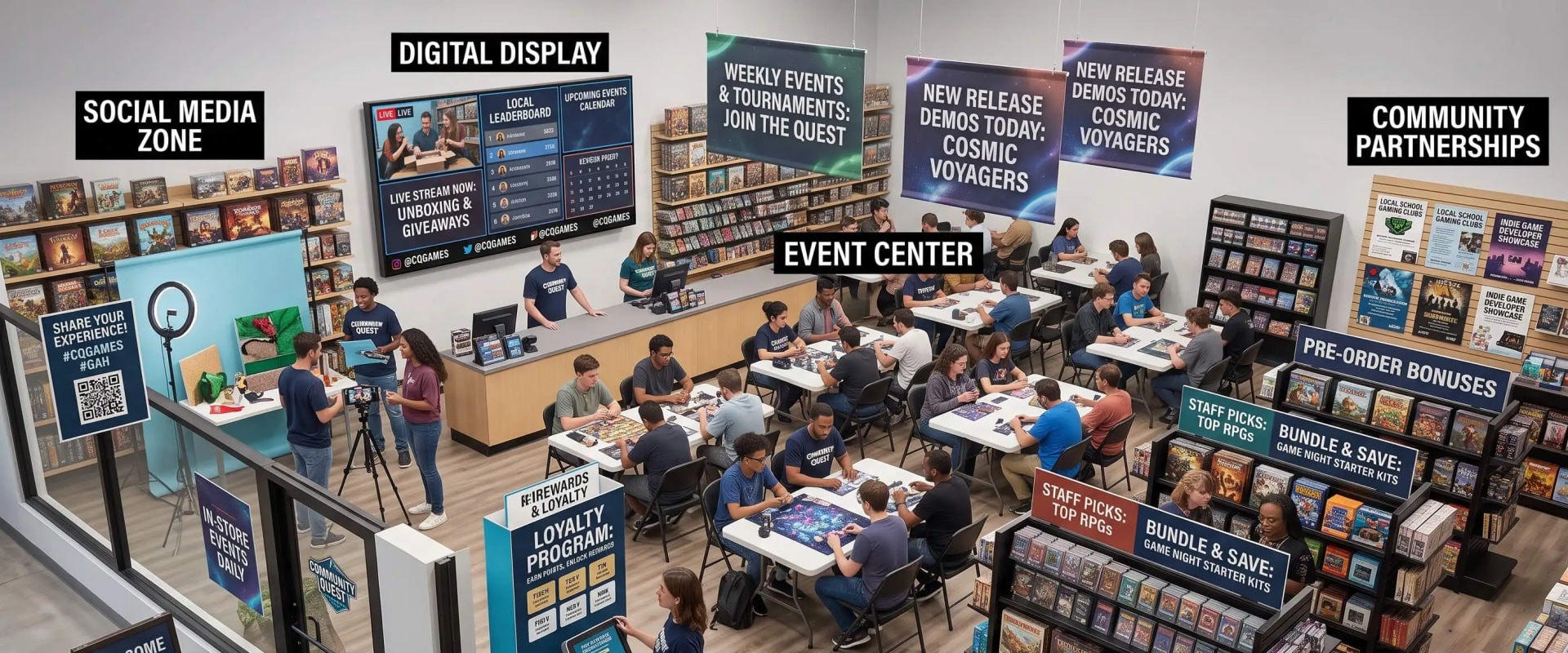
Twenty chairs, four players, and a stack of prize support you already paid for. That’s what a nine-day promotion window buys you.
I’ve heard the postmortem enough times to recite it. Wrong format, wrong night, wrong neighborhood, nobody comes out anymore. Almost never true. The event was fine; the announcement went up nine days out and lived in one Facebook post with eleven likes.
Six weeks buys a full room instead. Same event, same prize pool, same Tuesday… What changes is how long players had to hear about it, and how many different places they heard it from. So this isn’t a list of event ideas. It’s a calendar: a countdown from the day you pick the date to three days after the last player goes home, with the specific move to make at each mark. Promotion is one piece of game store marketing as a whole; it decides whether anybody ever sees the rest.
TL;DR Quick Answers
Game Store Marketing
Game store marketing is everything a friendly local game store (FLGS), hobby shop, or game café does to get new players through the door and keep the regulars coming back. It runs on community and events rather than discounts, because a physical store can't out-price Amazon and doesn't need to.
What works, in the order I'd tackle it:
Google Business Profile, filled out completely. Hours, photos, event calendar, all of it. Free, and it's how somebody two neighborhoods over finds you at all.
An email list tied to your event calendar. One short note about Thursday's game night beats almost any paid ad you could run for the same money.
Events people can walk into cold. Learn-to-plays, beginner nights, tournaments. Start promoting six weeks out, not nine days out.
One social platform, chosen because your regulars already live there. Twice a week for six months beats daily for two weeks and then silence.
Paid ads last, once the free channels are actually working.
The part most owners miss: your real competition isn't the shop across town, and it isn't Amazon… It's the couch. Everything above is just making the trip feel worth it.
Top 6 Takeaways
Six weeks, not nine days. The promotion window decides more than the event concept does, and everything else here is downstream of the date you start.
Build one event page and point everything at it. A single URL on your own site, with real times and capacity, is the only version of the event you control.
Your Google Business Profile is the cheapest reach you own. An Event post puts you in front of people searching for somewhere to go who have never heard of your store.
Ask five regulars by name. Individually, in person, each bringing one person. A general “bring a friend” post has never filled a table.
The last ten minutes outperform the first six weeks. Announce the next event before anybody leaves and you start the next cycle with a room instead of an empty calendar.
Write the numbers down. Seats, new emails, register total against a normal weeknight. Without that, every event you run is a guess.
Why Timing Beats The Idea
Ask ten owners why an event underperformed and nine will relitigate the event itself, arguing about the format or the night or the price. Almost nobody audits the promotion window, which is usually where the failure actually lives.
Here’s the arithmetic. Your regulars need to run into a thing three or four times before it lands on their calendar. Everybody else needs to run into it more than that, and at least once somewhere you don’t control… a search result, a Discord, somebody at work. Nine days doesn’t leave room for either. Six weeks does.
The good news is that demand isn’t your constraint. The hobby channel just posted its seventeenth straight year of growth, and the same white paper reports that most consumers are actively trying to spend less time on a screen. The people you want are out there, looking for somewhere to be. Your problem is reach, not persuasion—and that’s exactly where effective board game copywriting services help by turning your store, events, and community into content that local players and search engines can actually find.
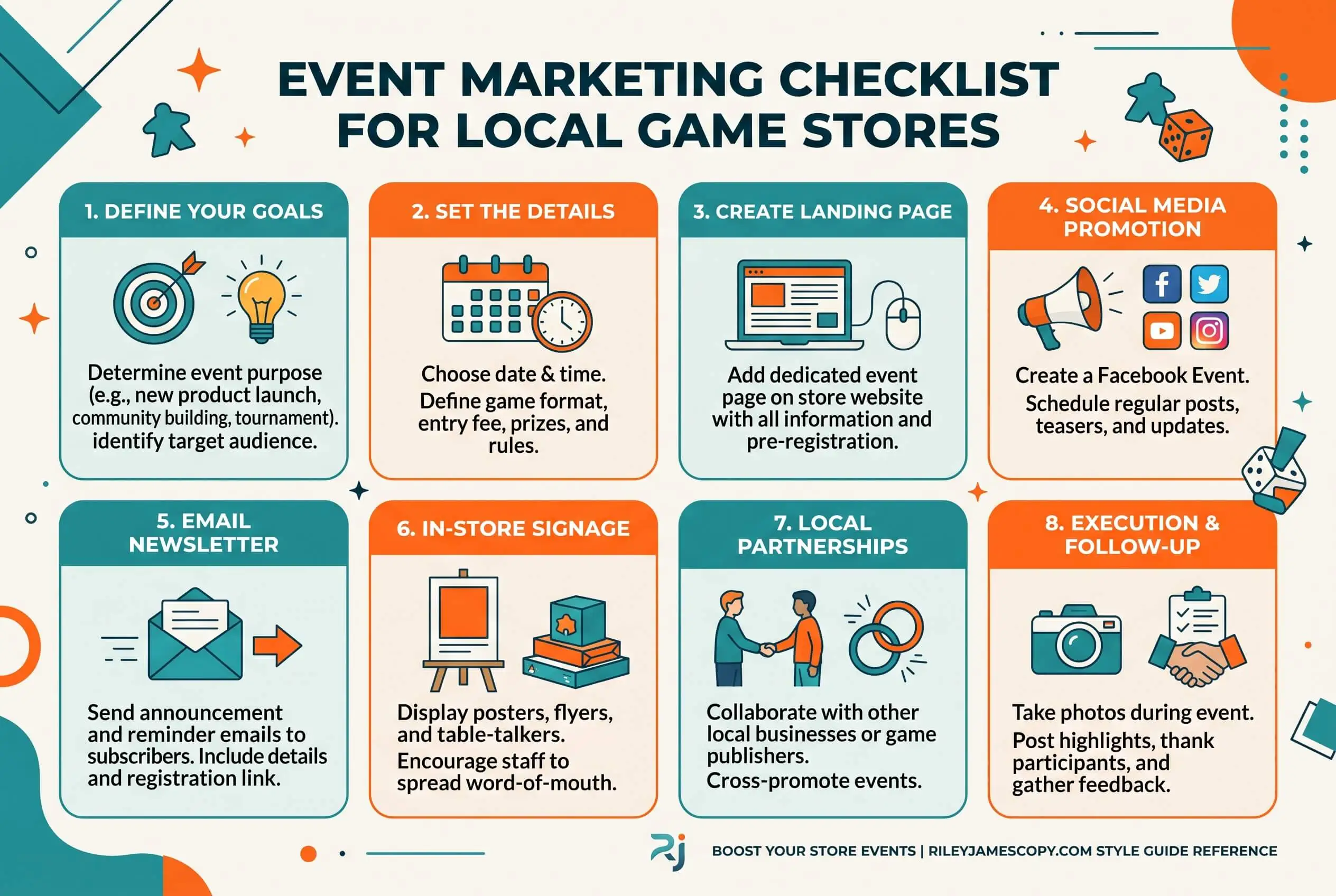
The Six-Week Game Store Event Marketing Checklist
Six To Four Weeks Out: Lock The Date
Check the release calendar before you check the blank one. Prerelease windows, seasonal program launches, and the fixed industry dates all come with demand already attached. Inventing a night in a dead week means building interest from scratch.
Say who it’s for in one sentence, out loud. “Lapsed Commander players who drifted off when we moved from Thursdays” is a plan. “Magic people” is a hope.
Set the seat count from your table count, not your optimism. A room at capacity is a story people tell afterward… so is a half-empty one.
Decide now what success looks like, and put a number on it: seats filled, new email addresses, register total against a normal weeknight. Write it on the whiteboard. You’ll want it in six weeks.
Order prize support, demo copies, and teaching decks against the real deadlines, because excellent promotion for an event with no product is worse than running no promotion at all.
Put one name on it. Not “the team.”
Four To Three Weeks Out: Build The Places People Find It
One event page on your own site. A single canonical URL carrying the date, start and end time, address, price, and capacity in plain text. Everything else points here. It’s also the only page in this checklist that should carry Event structured data.
A Google Business Profile Event post. Title, start and end date, start and end time. This is the most underused free tool in local retail, and it’s what surfaces when somebody two neighborhoods over types “board game night near me.” Leave the times off and Google renders it as an all-day event. Keep phone numbers out of the description; Google rejects those.
List it wherever your publishers list events, so it lands in the official store locators your players already check.
Facebook event and Discord event. Both. Pin the Discord one.
Photograph the signage going up. That’s free content for week three.
Three To Two Weeks Out: First Contact
Email one, to the whole list. What it is, who it’s for, why this night and not just any Tuesday. Keep it short.
Give your staff one sentence to say at the register, every transaction, all week. It’s the highest-converting channel in the building and it costs nothing but the asking.
Pick five regulars by name and ask each of them to bring one person. Individually, face to face. A general “bring a friend!” post has never once filled a table.
Signage up and readable from the sidewalk.
Two Weeks To One Week Out: Reach Past The Regulars
Email two, all logistics. What to bring, where to park, how long it runs, and whether a total beginner is welcome. Answer that last one explicitly and in writing; it’s the single question keeping people home.
Spend one hour submitting to free local calendars. The library, the city events page, the regional subreddit, the local Discords, the community paper.
Post at a cadence you can actually hold. Twice a week for three weeks beats daily for four days and then silence.
If the event has a hook (a charity tie-in, a first-in-town, a hundredth session) send it to the local paper or newsletter. Sometimes they bite.
Final Week And The Day Itself: Convert
Email three, forty-eight hours out. Last call, seats remaining, one line on what to expect.
Confirm staffing, table layout, teaching copies, and a run sheet with actual times on it.
Somebody greets every person who comes through the door. Name tags. A sign-up sheet that feeds the email list… that sheet is the most valuable object in the room.
Photos, permission asked first.
The ten minutes that matter most are the last ten. Before anyone leaves, tell them the date of the next one. Out loud, to the whole room.
Put the obvious purchase within arm’s reach. Sleeves, dice, singles, and coffee. Entry fees are not the revenue.
H3 Two To Three Days After: Compound It
Recap post with photos, while the room still feels recent.
Email the attendees specifically. Different list, different message than the main one.
Push the photos to your Google Business Profile.
Ask three attendees for a review. Individually, by name.
Log your numbers against what you wrote on the whiteboard six weeks ago. Everybody skips this step, and it’s the one that makes the next event easier to fill… because now you know which of these moves actually moved anything.
“After five-plus years writing for tabletop clients, the pattern I keep running into isn’t a marketing problem; it’s a calendar problem. The stores that fill a room aren’t more creative than the ones that don’t. They’re earlier. Same event, same prize pool, same night of the week: start at six weeks and your regulars have run into it four separate times, and at least one of those times it came from a friend instead of from you. Start at nine days and it’s one post they scrolled past on a Tuesday. Nobody wants that to be the answer, because there’s no clever idea in it and it’s mostly just a reminder in your phone. It’s still the answer.”
7 Essential Resources
Every one of these comes straight from the source: the publishers who run the play programs, or the platform your customers are searching on. Skim whichever matches where you’re stuck.
1. The Calendar Your Event Date Should Be Built Around
Key dates, scheduling windows, and program news for member stores. If you run any Wizards title, next quarter’s demand is already published here.
Source: Wizards Play Network: Retailer Success Hub
2. Free Promotional Assets You’re Probably Not Using
A walkthrough of the WPN site, including the Events Calendar and the Marketing Materials section. Official posters, logos, and images built for exactly the signage and social posts in week four of this checklist.
Source: Wizards North America: Using the Wizards Play Network Website
3. What To Actually Run, If You’re Out Of Ideas
Wizards now runs D&D organized play in seasons, with defined event types like Encounters Celebration and weekly play. Useful if you’d rather plug into a program that already has a calendar than invent a night from nothing.
Source: WPN: D&D Organized Play — New Seasons, Programs, and Event Types
4. The One Industry Date Worth Planning A Whole Quarter Around
Free RPG Day is a fixed annual traffic event, and the organizers ship free products to every participating store. Retailer sign-up and kit ordering happen well in advance, so get it into your planning before the window closes.
Source: Free RPG Day
5. How To Post An Event Where Strangers Will See It
Google’s own documentation on Business Profile posts, including the fields an Event post requires and the rules Google uses to reject one. Read the part about phone numbers before you write one.
Source: Google Business Profile Help: Create and manage posts
6. How To Mark Up Your Own Event Page So Google Understands It
The technical spec for Event structured data, including the part where Google requires your event to be publicly bookable and held at a physical location. This belongs on your store’s event pages, not on articles about events.
Source: Google Search Central: Event structured data
7. The Trade Group That Exists To Help You Run This Better
GAMA is the nonprofit trade association for the hobby games industry. Its retailer resources cover distributors, industry events, and retail practices built specifically for stores like yours.
Source: GAMA: Retailer Resources
These resources help game stores plan events, promote them effectively, and improve visibility through official programs and Google best practices. Whether you're organizing organized play, optimizing event pages, or looking for long-term growth, the same strategic approach used by a top ESG marketing agency—building sustainable community engagement, trusted partnerships, and consistent visibility—can strengthen your store's marketing over time.
Supporting Statistics
1. The Money Is Moving Toward Stores Like Yours
The hobby games market grew roughly 40% in 2025, to an estimated $3.66 billion, and the hobby channel specifically was up around 32%. That’s its seventeenth consecutive year of growth. Whatever is wrong with a slow Tuesday, it isn’t the size of the audience.
Source: ICv2: Big Growth in Hobby Games in 2025
2. Your Customers Are Looking For A Reason To Put The Phone Down
Per Circana data presented in ICv2’s 2026 hobby games white paper, 53% of consumers are trying to cut their screen time, up twenty points in two years. Research from L.E.K. Consulting found roughly two-thirds of Gen Z prefer shopping in person. An in-store event isn’t swimming against the current; it’s the thing they’re already looking for.
Source: ICv2 Hobby Games White Paper, GAMA Expo 2026
3. In-Store Events Are Industry Infrastructure, Not A Local Experiment
Free RPG Day ran its nineteenth annual event in June 2026 across more than 700 stores worldwide, and participating retailers handed out roughly forty free titles and accessories. The whole industry runs on the assumption that people will come in and sit down.
Source: Free RPG Day: About Us
The numbers point to one conclusion: demand for tabletop gaming continues to grow, more people are actively seeking in-person experiences, and industry-wide events consistently bring players into local stores. That opportunity is easiest to capture when your products and community are presented clearly online, making tabletop brand game accessories e-commerce copywriter expertise valuable for turning game accessories, events, and store offerings into persuasive content that attracts both search traffic and loyal customers.
Final Thoughts & Opinion
Here’s where I land after a few years of writing for tabletop businesses. The promotion calendar is worth more than the event concept, and the follow-up is worth more than the promotion.
That’s an unpopular thing to say, because the concept is the fun part. Choosing the format, naming the night, making the flyer… that’s the part that feels like marketing. Meanwhile the two moves that actually decide the outcome are starting at six weeks instead of nine days, and spending the last ten minutes of the night telling everyone the date of the next one. Neither one is creative, both are tedious, and both work.
A few honest observations from the work:
Struggling stores almost never have a community problem. They have a reach problem and they’ve misdiagnosed it as a taste problem. “Nobody around here plays that” is usually “nobody around here has heard about it.”
Nobody counts. Owners will run twelve events in a year and not be able to tell you which one filled the room. Write the numbers down and the pattern shows up faster than you’d expect, usually inside three or four events.
The sign-up sheet is worth more than the entry fees. Every single night. Most stores treat it as an afterthought and leave it somewhere nobody walks past.
None of this needs a bigger budget. It needs a calendar — and the discipline to work backward from a date, which is genuinely harder than it sounds when you’re also ordering singles and covering the register.
Frequently Asked Questions
Q: How Far In Advance Should I Promote A Game Store Event?
Six weeks for anything you want to grow. Two weeks is enough to remind your regulars and not enough to reach anybody new, because outside traffic needs time to find you through search, a local calendar, or a friend. Standing weekly events are the exception; those run on rhythm and a short reminder cycle.
Q: How Do I Get Beginners To Actually Show Up?
Use the word “beginner” in the promotion, then say what happens when they arrive. “New players welcome” reads as boilerplate. “We’ll teach you, we have loaner decks, and nobody’s keeping score” is an answer. Most first-timers aren’t nervous about the game… they’re nervous about being the only person in the room who doesn’t know anyone.
Q: What Should I Put In A Google Business Profile Event Post?
Title, start and end date, start and end times. Omit the times and Google will display it as running all day, which is almost never what you want. Add a photo, a short description, and a button pointing at your event page. No phone numbers. Google rejects those posts.
Q: How Much Should I Charge For Entry?
Enough to cover prize support and staff time without becoming the reason somebody stays home. For a learn-to-play or a beginner night, free is usually right; you’re buying a future regular, not tonight’s ten dollars. For sanctioned or prize-heavy events, match what nearby stores charge and don’t apologize for it.
Q: My Events Always Draw The Same Six People. How Do I Grow Past That?
Your regulars are your distribution, not your ceiling. Ask five of them by name to each bring one person, and give them something concrete to say about why. Then get the event onto surfaces your regulars don’t control: your Google Business Profile, the library calendar, the regional subreddit. The same six people every time means every channel you’re using is one they already read.
Q: Do I Need To Run A Tournament, Or Is Casual Enough?
Casual is enough, and it’s often better. Tournaments serve players who already know they’re players. Learn-to-plays, board game nights, and open tables serve everyone else, including the parents and first-timers who tend to become the most loyal customers you have. Run both if you can staff both. If you can only run one well, run the welcoming one.
Let’s Fill Your Next Event
Pick the next event on your calendar. The real one, already on the whiteboard. Count backward six weeks from it. If that date is behind you already, start where you are and work the rest in order… a compressed version of this beats none of it. Along the way, remember the importance of sustainability in marketing: building consistent community relationships, repeat attendance, and long-term visibility will always outperform one-off promotions that fade as soon as the event ends.
Then measure the night against a normal weeknight and write the number down. That’s how you find out which of these moves is doing the work in your store, and it isn’t always the one you’d guess.
And if all of that reads like one more job on top of running the register, ordering singles, and closing on Fridays, that’s fair. It’s also the sort of thing worth handing off to somebody who already knows what a prerelease is. The wider FLGS marketing picture is where that conversation starts.