A shopper opens your dice tray listing, reads three lines, and clicks back to the search results. You never learn why. I do this for a living, so here's the answer nine times out of ten: it wasn't the photo, and it wasn't the price. It was the words. The tray was beautiful and the copy read like a packing slip.
I'm a forever-DM in Spokane, and I write product pages for tabletop brands. This is the part makers hate to hear. Your buyer can't feel the felt, heft the walnut, or hear the dice settle, so your copy is the only thing standing in for all of it. When the copy goes flat, a great accessory reads like a spare part, and a fair price starts to feel like too much.
Premium copy for tabletop accessories doesn't come from bigger adjectives. It comes from the kind of specific detail that makes a buyer trust the number on the tag, especially when written by a tabletop brand game accessories e-commerce copywriter who understands what serious players actually notice.
TL;DR Quick Answers
Tabletop Brand Game Accessories E-Commerce Copywriter
A tabletop brand game accessories e-commerce copywriter writes the product pages, collection pages, and email flows for stores selling dice, playmats, sleeves, deck boxes, dice trays, and other gaming gear. The good ones play the games, so they sell on identity and table feel instead of spec lists, and they turn browsers into buyers.
What sets a specialist apart:
Leads with the moment of use, the roll, the shuffle, the reveal, then backs it with materials and dimensions.
Speaks the buyer's dialect: FLGS pickup, riffle shuffle, sharp-edge versus tumbled dice, BackerKit late pledges.
Builds trust into the page with a maker's story, honest reviews, and plain shipping and sizing.
Writes for search and AI by placing the keyword naturally and adding Product and FAQ structured data.
Top Takeaways
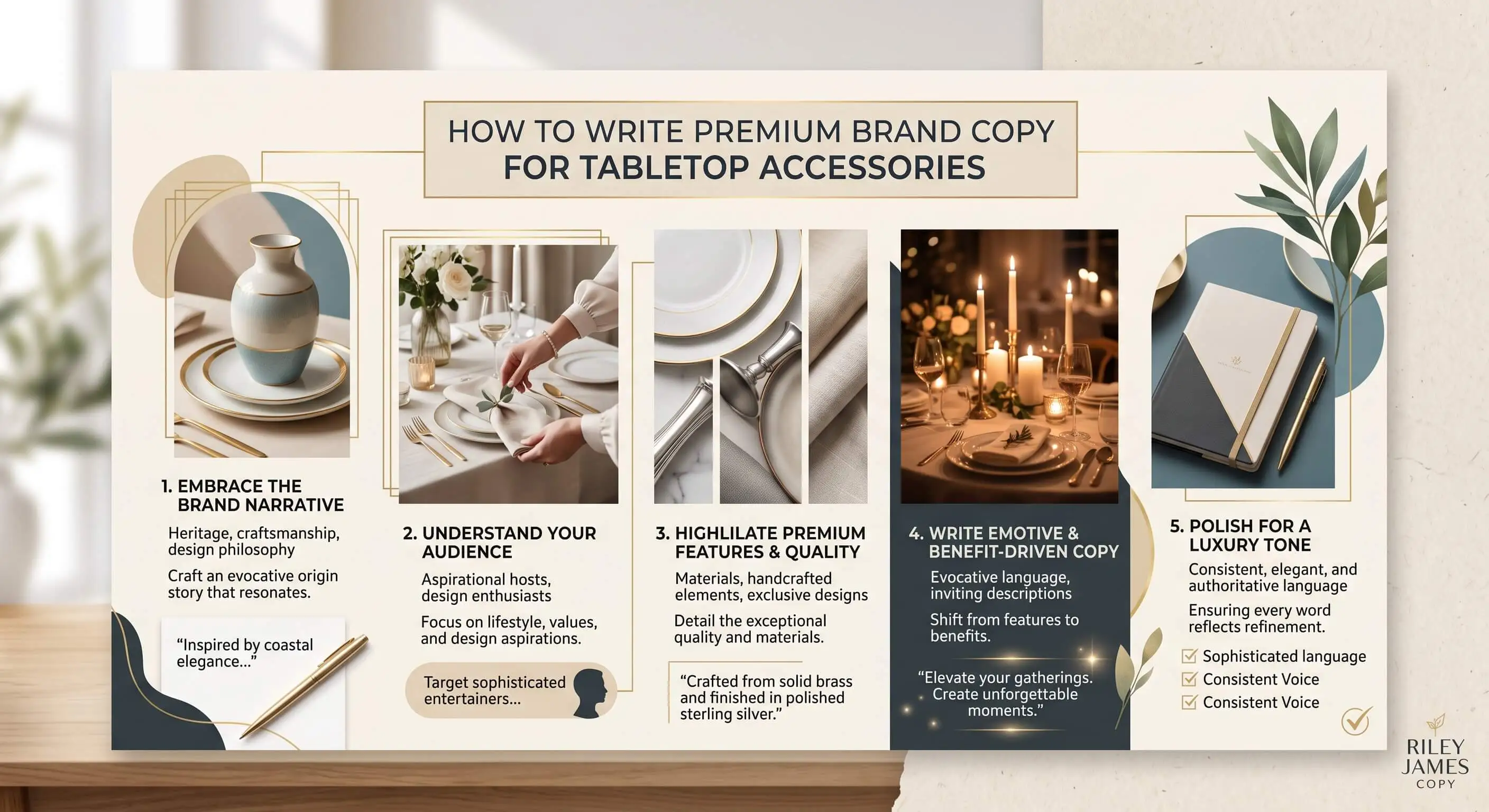
Sell the feeling first, then prove it with specs. A benefit beats a bare feature list every time.
Write for three buyers at once: the collector, the player, and the gift-giver.
Treat the page like a character sheet, where name, hero line, body, proof, and CTA each do a job.
Premium is specific and sensory. Retire "high-quality" and show the quality instead.
Trust signals are copied too. A maker's story, an honest review, and clear shipping all lower the risk of buying blind.
Good copywriting serves people and search at the same time, so the clarity that convinces a buyer also helps Google and AI read your page.
What premium copy actually means
Premium copy is specific copy. A spec sheet tells a buyer what a thing is. Premium copy tells them what it does at their table and why it beats the cheaper version three listings down.
Same playmat, described two ways:
Feature: "Neoprene playmat, 24 by 14 inches, stitched edges."
Benefit: "A 24 by 14 inch battlefield that lies flat on the first unroll, shrugs off spilled Mountain Dew, and holds its edge through years of Friday nights."
The second one costs nothing extra to produce. It just answers the question the buyer is actually asking, which is whether this thing will make their game better, and that kind of buyer-first clarity is where a Spokane copywriter can turn simple product details into stronger, more convincing copy.
Know who's actually reading
Three buyers open that same page, and they don't want the same thing. The collector cares about craft, so give them materials, finish, edition size, and how it looks on the shelf. The player cares about the table, so give them grip, durability, and how fast it sets up on game night. The gift-giver cares about the reveal, so give them the moment someone lifts the lid. Lead with the feeling each one came for, then back it with the spec that proves it.
The anatomy of a page that sells
I think about a product page the way I think about a character sheet. Every field pulls its weight.
Product name: clear first, clever second. "Dragon-scale dice tray" will outsell "The Hoard" every time, because people can actually search for it.
Hero line: one sentence that lands the single best reason to buy.
Body copy: benefits first, then the specs that back them up.
Materials and dimensions: the numbers a collector and a player both check before they trust you.
Social proof: drop one strong review into the copy itself, not just the star widget at the bottom.
A short FAQ: kill the objection that stalls the sale, usually shipping, sizing, or compatibility.
Call to action: tell them exactly what happens when they click.
Sound premium without the hype
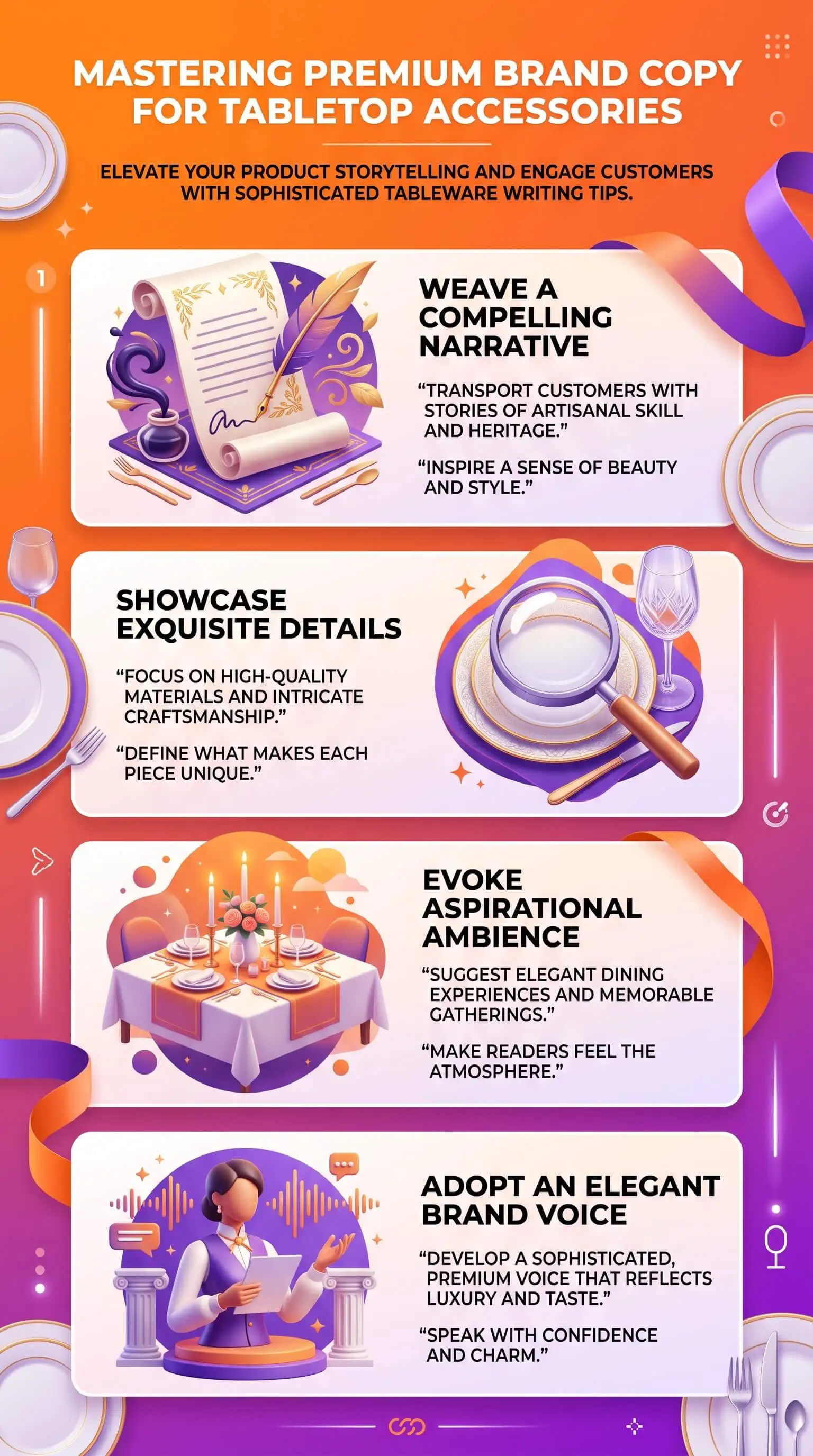
Premium is a matter of tone, not volume. "Hand-stitched wool that hushes every roll" beats "amazing high-quality premium dice tray," because one puts a picture in the buyer's head and the other just shouts. Hold one voice across every SKU, so your fifth product sounds like the same maker who wrote the first. And retire "high-quality." Everyone types it, nobody believes it. Show the quality instead: name the wood, the weight, the stitch.
Earn trust before the add-to-cart
Buying online is a bet against disappointment, and your copy is how you shorten the odds. A maker's story tells the buyer who's behind the felt. An honest review and a customer photo prove someone else took the bet and won. Plain shipping, returns, and sizing details pull the fear out of the click. Every one of those is a copy, and every one of them keeps a hand from drifting back to the wallet.
Help Google and AI find the page
A great copy nobody finds might as well not exist. Put your main keyword in the product title, the first line of the description, and one subhead, then write for people the rest of the way. Give every image an alt text that names the thing, like "walnut dice tray with green felt," not "IMG_4471." Add Product and FAQ structured data so search engines and AI assistants can read the page cleanly and quote it back to a shopper who asks. The same plain, specific writing that convinces a person also helps a machine understand what you sell, which is why the same approach matters whether you're selling tabletop accessories or working with a sustainability marketing agency on product visibility.
"After years of writing product pages for dice makers and small publishers, I've learned the thing makers resist hearing. Nobody pays a premium for an object. They pay for the feeling of owning it. The brands that win aren't the ones with the fanciest words. They're the ones that put the buyer at the table before a cent changes hands, the roll, the reset, the reveal, and let them feel it. Specs confirm a sale; story is what starts one."
7 Essential Resources
These are the references I actually send clients who want to sharpen their own pages before, or instead of, hiring me.
Nielsen Norman Group: Tips for Better Product Descriptions. Research on how people really read a description, including why the first line does most of the work.
Nielsen Norman Group: UX Guidelines for Ecommerce Product Pages. A working checklist of what a page has to answer before a buyer will trust it.
Baymard Institute: Product Page UX Research. Usability findings on what makes shoppers stay or bail. Worth an afternoon.
Shopify: How to Write a Product Description That Sells. A practical template with examples and the sensory-language moves I lean on.
Salsify: 2025 Consumer Research Report. Recent survey data on how much product copy drives what people buy and return.
Google Search Central: Intro to Product Structured Data. The official spec for the Product markup that earns rich results on shopping searches.
Google Search Central: Creating Helpful, People-First Content. Google's own checklist for the experience and trust signals that rank, and that AI tools reward.
3 Statistics
1. Copy is a top reason people buy. Salsify's latest consumer research found that 77% of shoppers rated product titles and descriptions "extremely" or "very" important to their decision. Your words aren't filler; they're a deciding factor. (Salsify)
2. The table is growing. The global playing cards and board games market was worth 19.90 billion dollars in 2024 and is on track for 31.93 billion by 2030, an 8.3% annual clip. More buyers keep showing up, and sharper copy is how you keep them. (Grand View Research)
3. Most pages leave money on the table. Baymard found that up to 62% of leading ecommerce sites deliver a mediocre or worse product page experience. That's daylight for any brand willing to write better. (Baymard Institute)
Product copy that feels specific, trustworthy, and useful helps buyers understand why a dice set, screen, tray, miniature, or tabletop accessory is worth the price, making it a key part of DnD and TTRPG marketing.
Final Thoughts and Opinion
Here's my honest read after years in this niche. Most tabletop makers pour everything into the object and treat the copy like paperwork, and their sales show it. A gorgeous dice tray with a dead description is a natural 20 rolled behind the screen, where nobody sees it land.
The upside is that a copy is the cheapest upgrade you own. You don't need new tooling, a bigger factory, or a fatter ad budget, only words that respect the buyer, name the moment, and prove the quality the product already has. In a market this crowded, the brands that write like they mean it are the ones that get to charge what their work is worth.
Frequently Asked Questions
How long should a tabletop product description be?
For most accessories, 150 to 300 words does the job. That's room to lead with a benefit, list the specs a collector checks, and answer the one objection that stalls the sale, without drowning the buyer in text. Pricier or more complex pieces can run longer.
What makes copy feel premium instead of generic?
Specifics and the senses. Premium copy names the exact material, the exact moment you'd reach for the thing, and the exact payoff, so the reader can picture owning it. Generic copy leans on empty words like "high-quality" that every competitor also types.
Do product descriptions actually help SEO?
Yes. Your description is usually the biggest block of indexable text on the page. Put your main keyword in the title, first line, and one subhead, then write naturally for people, and you rank while still converting the shopper who lands there.
Should I use AI to write my product copy?
AI drafts fast, but it drafts generically. Feed it your real materials, dimensions, and voice, then edit hard for specifics and first-hand detail. A copywriter who plays the games, or a sharp human pass, is what turns a draft into copy that sells.
When does it make sense to hire a copywriter?
When the catalog is big, the launch matters, or the revenue at stake beats the cost of doing it yourself. Hiring pays off fastest on your top-traffic products, where a small lift in conversion compounds across every visitor after.
Ready to Make Your Accessories Sell Themselves?
Your product hits as hard as the craft you put into it. Your page should too. If you'd rather hand it to someone who actually plays the games than write it all yourself, that's what I do at Riley James Copy: product pages for dice makers, playmat printers, and tabletop publishers who want to charge what their work is worth, especially when the product page needs to support a stronger board game crowdfunding strategy. Bring me your best accessory and I'll make the page live up to it.